

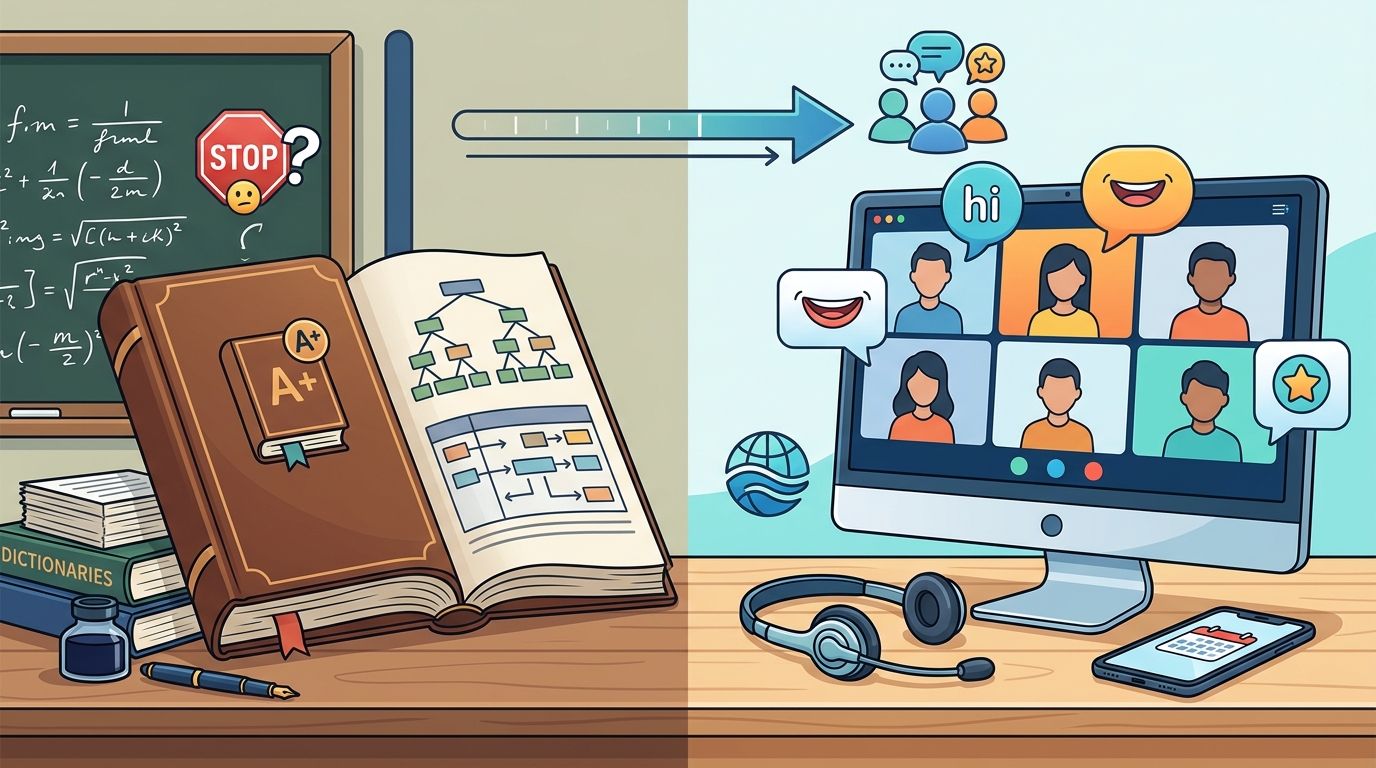
Conversational Spanish classes prioritize active speaking and real-time interaction, whereas traditional methods focus on memorizing rules and vocabulary lists. This shift from passive study to active production is the primary driver of speaking confidence. Pura Buena Onda, a 19-year-old online Spanish school, uses this conversational approach to help adults build fluency through consistent, low-pressure practice.
The Core Difference in Learning Focus
Traditional language instruction often treats language as a subject to be studied rather than a tool to be used. Students spend significant time on grammar worksheets, verb conjugation drills, and reading comprehension. While this builds a theoretical foundation, it rarely translates to the ability to speak spontaneously. A conversational class is a live session where the primary goal is communication, not just accuracy.
In a traditional setting, the teacher speaks and the student listens or writes. In a conversational setting, the dynamic is reversed. The student must produce language to participate. This forces the brain to process information in real time, which is essential for developing fluency. The focus shifts from getting every word perfect to getting the message across.
Real-Time Feedback and Correction
One of the most significant advantages of conversational learning is immediate feedback. In a traditional classroom, a student might make a grammatical error on a test and receive a grade days later. By then, the mistake has already been cemented in their memory. In a live conversation, a teacher can correct an error the moment it happens.
This real-time correction helps students understand why a phrase sounds unnatural or incorrect. It allows them to adjust their speech patterns instantly. At Pura Buena Onda, teachers provide this guidance in a supportive environment. The goal is not to shame mistakes but to guide students toward more natural phrasing. This immediate loop of action and feedback accelerates learning significantly.
Overcoming the Speaking Barrier
Many adult learners suffer from a speaking barrier. They may understand Spanish well but freeze when asked to speak. This is often due to a lack of practice in a low-stakes environment. Traditional methods rarely address this anxiety because they do not require spontaneous speech. Conversational classes are designed specifically to break down this barrier.
By starting with simple, relatable topics, students build confidence gradually. They learn that making mistakes is a natural part of the process. The relaxed atmosphere of a small-group setting helps reduce the fear of judgment. As students become more comfortable, they begin to take risks with their language. This willingness to experiment is crucial for moving from intermediate to advanced proficiency.
The Role of Consistency and Community
Language learning is highly individual, but consistency is a universal requirement. Traditional courses often rely on weekly homework, which can be easily skipped. Conversational classes create a sense of accountability. When you know you will be speaking with others, you are more likely to prepare and show up. This regular exposure to the language reinforces new vocabulary and structures.
Community also plays a vital role in this process. Learning with peers who share similar goals creates a supportive network. Students often form friendships that extend beyond the classroom. This social connection makes learning more enjoyable and sustainable. At Pura Buena Onda, the community aspect is central to the experience. Students are part of a group that encourages each other to keep practicing.
Integrating Grammar into Conversation
A common misconception is that conversational classes ignore grammar. In reality, grammar is still present, but it is taught in context. Instead of memorizing a list of subjunctive verbs, students encounter them in natural dialogue. This contextual learning makes the rules more memorable and easier to apply. Students learn when and why to use specific structures, not just how to conjugate them.
This approach ensures that grammar serves communication. It prevents the common issue of knowing the rules but not knowing how to use them in real life. By integrating grammar into conversation, students develop a more intuitive understanding of the language. This leads to more natural and fluid speech over time. The focus remains on using the language, with grammar as a supporting tool rather than the main event.
Key Takeaways
- Conversational classes prioritize active speaking, while traditional methods focus on passive study.
- Real-time feedback in conversation helps correct errors immediately, accelerating learning.
- Low-pressure environments help overcome the anxiety that often blocks adult learners.
- Consistency and community accountability are key to maintaining progress in language learning.
- Grammar is taught in context within conversational classes, making it more practical and memorable.
- Fluency is a long-term goal that depends on consistent practice and exposure.
Frequently Asked Questions
Do I need prior Spanish knowledge to join a conversational class?
No, no prior Spanish knowledge is required. Beginners can start with classes designed for their level. The focus is on building basic communication skills from the ground up.
How are conversational classes different from private lessons?
Will I still learn grammar in a conversational class?
Yes, grammar is integrated into the conversation. Teachers correct errors and explain rules as they arise in natural dialogue. This contextual approach makes grammar more practical.
How long does it take to see progress in speaking?
Progress depends on consistency and individual goals. Many learners notice increased confidence within a few months. Sustained practice over a longer period is key to developing fluency.
Are the classes held online?
Yes, all classes are held 100% online. This allows students from anywhere to participate in the same live, interactive sessions.
What is the size of the small-group classes?
Small-group classes have up to 6 students. This size ensures that each student gets frequent chances to speak and participate actively.