

Whether you have been studying Spanish for months or are just getting started, you probably want to see faster results. The good news is that improving your Spanish does not require moving to a Spanish-speaking country or spending hours a day buried in textbooks. With the right mix of conversation practice, daily immersion habits, and structured guidance, you can accelerate your progress dramatically. In this guide, we break down seven research-backed strategies that real Spanish learners use to level up, plus practical ways to start applying them today from wherever you are.
1. Speak Spanish from Day One
Conversational practice is the single most effective accelerator for language learning. Studying grammar rules on paper or completing app exercises can build a foundation, but they will not teach your mouth and brain to produce language in real time. As language experts consistently emphasize, the only way to become confident having conversations in Spanish is to have lots of conversations in Spanish.
At Pura Buena Onda, beginner students have their first real conversation on day one, focusing on topics from their own lives rather than generic textbook dialogues. This approach is grounded in the principle that when language is connected to your real world, it sticks.
Find a Speaking Partner
If you do not yet have a class, find a tandem partner through local meetups or apps. Even 15 minutes of spoken Spanish each day trains your brain to stop relying on English as a crutch.
2. Build Daily Micro-Immersion Habits
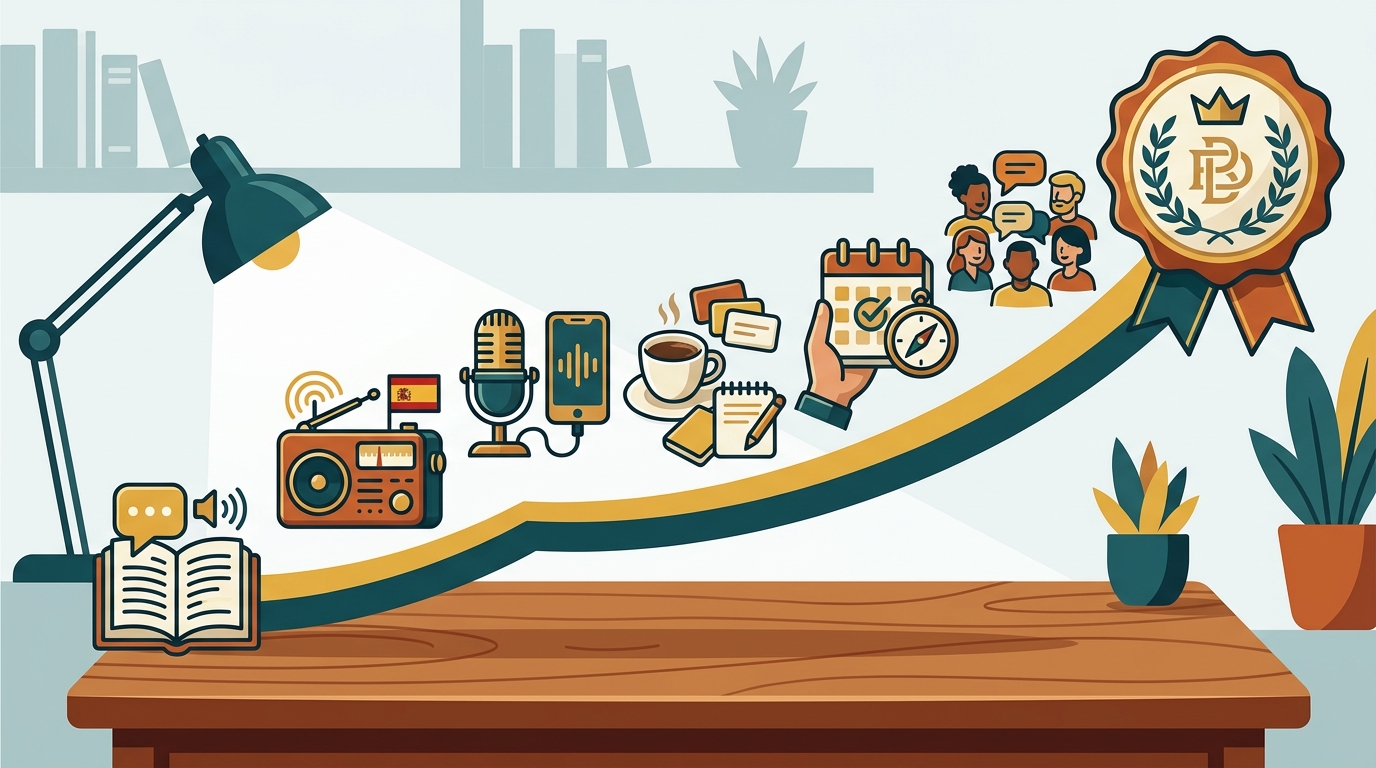
Micro-immersion is the practice of weaving small amounts of Spanish into your daily routine so your brain encounters the language constantly. You do not need to block out hours; short, consistent exposure beats occasional marathon study sessions every time.
Simple starting points include switching your phone and social media to Spanish, following Spanish-language creators on YouTube or TikTok, and narrating your day in your head using Spanish. According to Berlitz, combining retrieval practice with daily immersion and guided instructor feedback is the fastest path to fluency.
The 10-Minute Rule
Dedicate just 10 focused minutes each day to active Spanish practice. Over a month, that adds up to over five hours of targeted learning, which is often more productive than a single weekly cram session. Pura Buena Onda even offers a 30-for-30-in-30 challenge designed around this principle.
3. Use Spanish Media for Listening Practice
Listening comprehension is a skill that improves with volume. Watching TV shows, movies, and YouTube channels in Spanish develops your ear for natural speech patterns, slang, and regional accents. Start with English subtitles, then switch to Spanish subtitles, and eventually go subtitle-free.
Podcasts are equally powerful. They expose learners to diverse accents and colloquial expressions, which deepens your understanding of everyday language. Pair media consumption with your weekly conversation classes to practice new vocabulary in a live setting.
4. Take Structured Conversation Classes
Structured classes provide something self-study cannot: real-time corrective feedback from a qualified instructor. A conversation class is a guided session where you practice speaking and listening with a teacher and peers in a low-pressure environment.
Consistency is incredibly important when learning a language. That is why schools like Pura Buena Onda offer monthly memberships with flexible scheduling, including group, semi-private, and private formats. For intermediate learners stuck at a plateau, private or semi-private sessions can provide the focused attention needed to break through.
Group vs. Private: Which Is Right for You?
Group classes expose you to vocabulary you would never bring up on your own, expanding your knowledge organically. Private classes, on the other hand, let you move at your own pace. Many learners at the B1 level and above find that one-on-one attention really does speed things up.
5. Read and Write in Spanish Regularly
Reading is a vocabulary multiplier. People who read regularly in their second language develop a notably wider vocabulary than those who do not. Start with content you enjoy, whether that is news articles from El Pais, short stories, or social media posts.
Writing reinforces what you learn. Keeping a simple journal in Spanish, even just three sentences about your day, helps you recall vocabulary and build sentence structure naturally. Reading aloud is also a powerful technique that trains your tongue and mouth muscles to pronounce Spanish sounds confidently.
6. Embrace Mistakes and Stop Translating
A growth mindset is the belief that abilities develop through effort rather than being fixed traits. In language learning, this means treating mistakes as data, not failure. Making mistakes when speaking a second language is perfectly normal, and the learners who improve fastest are those who speak anyway.
The other critical shift is to stop translating from English in your head. Even if you know everything someone said, if you have to translate, you will never keep up with native-speed conversation. Thinking directly in Spanish, even in simple sentences, rewires your brain for fluency. Pura Buena Onda's conversation-first approach is built around this exact principle.
7. Compare Learning Methods at a Glance
| Method | Best For | Speed of Progress | Cost |
|---|---|---|---|
| Language Apps (Duolingo, Babbel) | Vocabulary basics | Slow to moderate | Free to $15/mo |
| Self-Study (textbooks, grammar books) | Grammar foundations | Slow | $20-$50 one-time |
| Conversation Classes (e.g., Pura Buena Onda) | Speaking and listening fluency | Fast | Monthly membership |
| Private Tutoring | Personalized gaps and plateaus | Fastest | $$$ per session |
| Immersion Abroad | Full cultural and language immersion | Very fast | High (travel + living) |
The most effective learners combine multiple methods. A structured conversation class paired with daily micro-immersion habits and media exposure creates a powerful learning loop that no single method achieves alone.
Key Takeaways
- Start speaking Spanish from day one; studying about a language is not the same as speaking it.
- Build daily micro-immersion habits like switching your phone to Spanish and narrating your day.
- Use Spanish TV, podcasts, and music to develop natural listening comprehension.
- Take structured conversation classes with real-time instructor feedback for the fastest gains.
- Read and write in Spanish regularly to expand vocabulary and reinforce grammar naturally.
- Embrace mistakes as a normal part of the process and stop translating from English in your head.
- Combine multiple methods for the best results; no single app or class does it all.
Frequently Asked Questions
How long does it take to become conversational in Spanish?
With consistent practice of 3 to 4 hours per week, most learners reach a conversational level in 6 to 12 months. Daily immersion and structured classes can shorten that timeline significantly.
Are language learning apps enough to become fluent?
Apps are a great supplemental tool for vocabulary and grammar basics, but they are not sufficient on their own. Real fluency requires speaking with other people and receiving corrective feedback in live conversation.
What is the best way to improve my Spanish listening skills?
Watch Spanish-language TV shows and movies, listen to podcasts, and gradually move from English subtitles to Spanish subtitles to no subtitles at all. Pair this with weekly conversation practice to reinforce what you hear.
Should I take group classes or private lessons?
Group classes are excellent for beginners and intermediate learners because they expose you to diverse vocabulary and help build community. Private lessons are ideal if you are stuck at a plateau or want to accelerate past the B1 level.
How can I practice Spanish if I do not live in a Spanish-speaking country?
Online conversation classes, language exchange partners, Spanish media, and daily habits like switching your devices to Spanish are all effective. Schools like Pura Buena Onda offer online classes accessible from anywhere in the world.
What is conversational immersion?
Conversational immersion is a teaching method where classes are conducted primarily in the target language, emphasizing real-time speaking and listening over textbook grammar drills. It mirrors how children naturally acquire language.
How do I get past an intermediate Spanish plateau?
Plateaus at the B2 level are common. Switching to private classes for six to twelve months, increasing your reading in Spanish, and actively thinking in Spanish throughout the day can help you push past that wall.
Is it too late for adults to learn Spanish?
Absolutely not. Adults bring life experience and motivation that younger learners often lack. The key is choosing a method focused on speaking, not memorization. Check out Pura Buena Onda's post on why adults struggle to learn Spanish for practical solutions.
Ready to Start Speaking Spanish?
The fastest way to improve your Spanish is to start speaking it with real people in a supportive environment. Pura Buena Onda offers online conversational Spanish classes with flexible scheduling, small groups of six students maximum, and eight levels from beginner to fluent. Sign up for a level assessment today and find out exactly where you are and what class is right for you.