

Learning Spanish is one of the most rewarding things you can do, but it can also feel painfully slow. Whether you want to connect with your Spanish-speaking partner, prepare for a trip to Latin America, or simply chat with your neighbors, the key is knowing which habits actually accelerate progress. The good news? You do not need to move abroad or study for hours every day. With the right strategies and consistent practice, you can see real improvement in weeks, not years. Below, you will find seven research-backed, teacher-approved tips to help you improve your Spanish language skills quickly and enjoyably.
1. Speak From Day One
The single fastest way to improve your Spanish is to open your mouth and use it. Active speaking is the practice of producing language in real time rather than passively consuming it. Many learners spend months studying grammar books before ever attempting a conversation, but this delays the exact skill they want to build.
Language experts consistently emphasize that learners who prioritize communication over perfection advance faster. As the team at Pura Buena Onda explains, speaking is where real learning happens. Try narrating your day in Spanish, even if it is just in your head at first.
2. Join Conversational Spanish Classes
Self-study has its limits. A conversational Spanish class is a structured session focused on real-time speaking practice with other learners and a native-speaking teacher. This format gives you something apps cannot: live human feedback.
At Pura Buena Onda, students practice speaking Spanish with real people, receiving real-time corrections and guidance from experienced teachers. Their small-group classes of 3 to 6 students run for 90 minutes, giving each person ample time to talk.
Group vs. Private vs. Self-Study
| Method | Speaking Time | Live Feedback | Accountability | Cost |
|---|---|---|---|---|
| Self-study (apps) | Low | None | Low | Free/$15/mo |
| Private lessons | High | Personalized | High | $$ |
| Small-group classes | Moderate-High | Teacher-guided | High | $ |
| Language exchange | Moderate | Informal | Low | Free |
If you prefer one-on-one attention, private Spanish lessons let you focus on your specific weaknesses at your own pace.
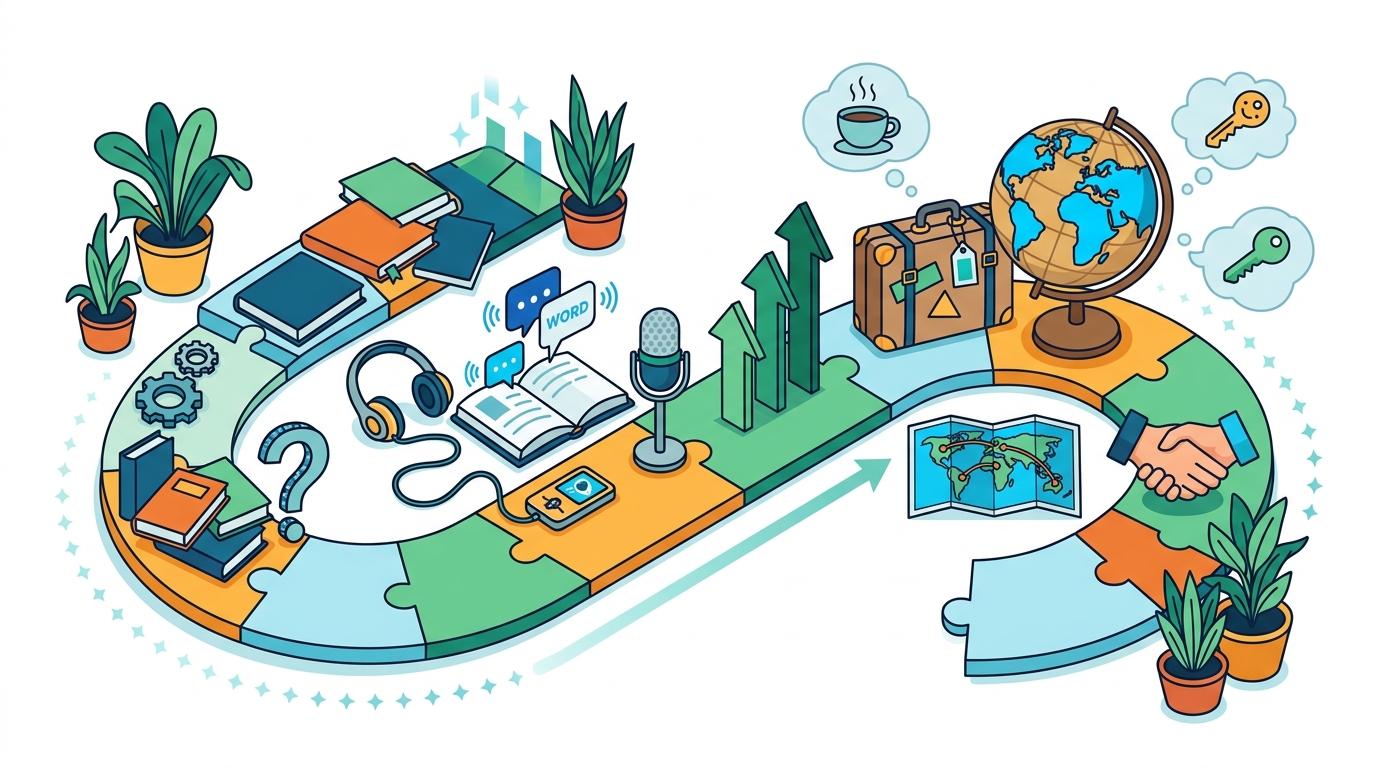
3. Immerse Yourself Daily Without Leaving Home
Immersion is the process of surrounding yourself with a target language so that your brain processes it continuously. You do not need a plane ticket to do it. Start by switching your phone, social media, and streaming apps to Spanish.
Watch Spanish-language TV shows and listen to podcasts during your commute. According to Preply's 2026 guide, changing your phone settings and listening to Spanish radio stations can turn idle scrolling into productive practice. Even 20 minutes a day of passive listening trains your ear to recognize natural speech patterns.
4. Set Specific, Measurable Goals
A language learning goal is a concrete, time-bound target that keeps you focused and motivated. Vague intentions like "practice more" rarely lead to results.
Instead, try goals like "hold a five-minute conversation about my weekend" or "learn 10 new food-related words by Friday." Structured challenges work exceptionally well. Pura Buena Onda's Spill the Chisme Spanish Challenge gives you 31 daily prompts to practice speaking and storytelling in the past tense, building confidence quickly.
5. Read Aloud in Spanish
Reading aloud does double duty: it builds vocabulary and trains your mouth muscles for Spanish pronunciation. Grab a short article, a blog post, or even a recipe and spend 5 to 10 minutes reading it out loud each day.
This is especially powerful for intermediate learners who understand written Spanish but freeze when speaking. Over time, reading aloud bridges the gap between comprehension and production. For deeper grammar work, courses like Perfecting the Preterit and Imperfect help you internalize tricky tense choices so they flow naturally in conversation.
6. Embrace Your Mistakes
Fear of making errors is the number one barrier for adult language learners. But research shows that learners who prioritize communication over perfection advance significantly faster. Making mistakes is not a sign of failure; it is a sign that you are pushing your boundaries.
Pura Buena Onda was built on this philosophy. As they describe it, their classes feel like "Happy Hour with friends" where you laugh, learn, and grow in a non-judgmental environment. If you have ever felt frustrated as an adult learner, know that every fluent speaker once stumbled through the same awkward sentences.
7. Track Your Progress and Get Feedback
Without feedback, you cannot correct persistent errors. Regular assessments help you see where your strengths and weaknesses lie. Pura Buena Onda offers a comprehensive Spanish evaluation that includes over 90 minutes of conversation and a detailed report across two sessions.
Tracking your level over time also keeps you motivated. Aim for consistent weekly practice rather than marathon weekend sessions. Research suggests that 3 to 4 hours per week can produce meaningful results within 6 to 12 months.
Strategy Comparison: Impact and Effort
| Strategy | Time Investment | Impact on Fluency | Difficulty to Start |
|---|---|---|---|
| Speak from day one | 15 min/day | Very High | Moderate (requires courage) |
| Conversational classes | 1.5-3 hrs/week | Very High | Low (just sign up) |
| Daily immersion | 20-60 min/day | High | Very Low |
| Set measurable goals | 5 min/week | Moderate | Very Low |
| Read aloud | 10 min/day | Moderate-High | Low |
| Embrace mistakes | Mindset shift | High | Moderate |
| Track progress/feedback | Monthly check-in | High | Low |
Key Takeaways
- Speaking practice is the single most effective accelerator for Spanish fluency.
- Conversational classes with native teachers provide feedback that apps cannot replicate.
- Daily immersion through media, phone settings, and music compounds quickly over weeks.
- Specific, measurable goals keep you accountable and focused.
- Reading aloud bridges the gap between passive comprehension and active speaking.
- Mistakes are essential to growth; a supportive environment makes all the difference.
- Regular assessments help you identify blind spots and celebrate progress.
Frequently Asked Questions
How long does it take to become conversational in Spanish?
Most dedicated learners reach a conversational level within 6 to 12 months of consistent practice. The U.S. Foreign Service Institute classifies Spanish as a Category I language, estimating roughly 600 to 750 class hours for professional proficiency. However, conversational comfort can arrive much sooner with the right methods.
Can I learn Spanish quickly with just an app?
Apps are great for vocabulary and basic grammar, but they fall short on speaking practice and real-time feedback. Combining an app with live conversational classes produces far better results than either method alone.
What is the best way to practice Spanish if I do not know any native speakers?
Online classes remove geographic barriers entirely. Pura Buena Onda's classes are held online in Pacific Time, making them accessible from anywhere. You can also join language exchange communities or Spanish-language social media groups.
How many hours per week should I study Spanish?
Research suggests 3 to 4 hours of focused practice per week delivers noticeable progress within a few months. Consistency matters more than volume; 30 minutes daily beats a single 3-hour session on the weekend.
Is it too late for adults to learn Spanish?
Absolutely not. Adults bring life experience, motivation, and analytical skills that younger learners lack. The key is finding a supportive, low-pressure environment where you feel comfortable making mistakes and trying new things.
What is the difference between group and private Spanish classes?
Group classes let you hear different perspectives and practice with peers, while private lessons offer fully personalized attention. Many students combine both for balanced progress.
Do I need to learn grammar to speak Spanish well?
Grammar is important for accuracy, but it should not come at the expense of speaking. Focus on communication first and refine grammar over time through courses like Pura Buena Onda's Subjunctive Made Simple or their Ser vs. Estar course.
Ready to Start Speaking Spanish?
Stop waiting for the "perfect moment" and start building your skills today. Pura Buena Onda offers relaxed, fun, and effective online Spanish classes designed to get you speaking from the very first session. Contact Pura Buena Onda to set up your first class and experience the difference that real conversation makes.