

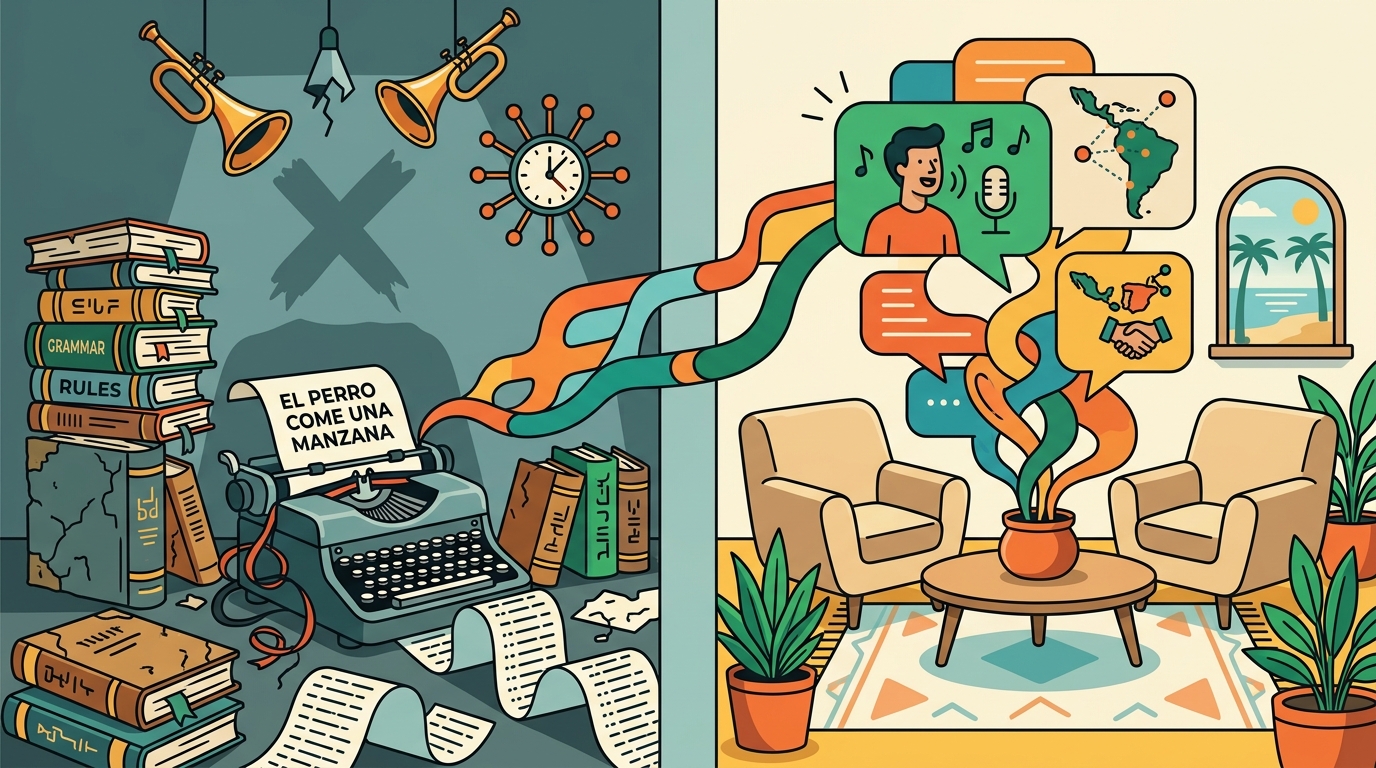
Traditional language learning often feels like a high-pressure performance review. You are forced to memorize rigid grammar rules and recite vocabulary lists until you can say "the dog eats an apple" without hesitation. However, language acquisition research consistently shows that fluency is not a product of rote memorization. It is a byproduct of active, low-stakes communication. When you remove the fear of judgment, your brain shifts from analytical processing to natural acquisition. This guide outlines exactly how to replicate that environment for yourself, whether you are a beginner or an advanced speaker looking to refine your conversational flow. (About Pura Buena Onda)
Why Relaxation is Critical for Fluency
Many learners hit a plateau not because they lack vocabulary, but because they suffer from "affective filter" blockage. This is a psychological barrier where anxiety prevents input from reaching the part of the brain responsible for language processing. When you are stressed, your body enters a fight-or-flight mode, which shuts down creative language production. (Blog Pura Buena Onda)
Conversely, relaxed immersion allows you to focus on the message rather than the mechanics. You stop translating word-for-word in your head and start thinking in the target language. This state is often described as being "in the zone." To achieve this, you must prioritize environments that value connection over correction. The goal is to make Spanish feel as natural as your morning coffee routine, not a chore you must complete.
Finding Your Safe Space
The most effective way to practice speaking is to join a community that explicitly rejects the "high school lecture" model. You need a group where the primary objective is connection, not perfection. This means finding instructors or peers who view mistakes as essential data points for learning, rather than failures.
Small Groups vs. Large Classes
Large classroom settings often force you to compete for speaking time. In contrast, small-group dynamics ensure that every participant gets significant airtime. When the group size is limited, you can engage in deeper, more nuanced conversations. You can discuss your actual life, your relationships, and your daily frustrations, rather than just reciting textbook dialogues about weather or food.
The Role of Humor
Laughter is a powerful lubricant for social interaction. When you laugh, your tension drops, and your willingness to take linguistic risks increases. Look for programs that incorporate humor and casual banter into their curriculum. If you are not smiling, you are likely not in the right environment for relaxed practice.
Structuring Your Practice
Consistency beats intensity when it comes to language acquisition. Trying to study for five hours once a week will yield poor results compared to thirty minutes every day. A structured yet flexible approach helps you build a sustainable habit without burning out.
The 30-Minute Daily Rule
Commit to a daily practice window of approximately thirty minutes. This duration is long enough to engage in meaningful conversation but short enough to maintain high energy and focus. During this time, you should be actively speaking, listening, and reacting. Passive listening, such as watching a movie, is helpful but does not replace the cognitive load of active production.
Flexible Scheduling
Life happens. A rigid schedule can lead to guilt and eventual abandonment of the habit. Choose a program or method that allows you to join sessions when you have the energy. Whether it is a morning class or an evening session, the key is that the option exists for you to participate without penalty.
Overcoming the Fear of Mistakes
The fear of sounding foolish is the number one barrier to speaking Spanish. However, native speakers generally appreciate the effort more than they judge the accuracy. In a relaxed environment, errors are normalized and often laughed about together.
To overcome this, you must reframe your mindset. View every mistake as a successful attempt at communication. If you were understood, you succeeded. The correction that follows is a gift, not a criticism. By surrounding yourself with supportive peers, you create a safety net that encourages you to try harder and speak more freely.
Comparing Practice Methods
Not all speaking opportunities are created equal. Below is a comparison of common methods to help you choose the best fit for your personality and goals.
| Method | Environment | Speaking Time | Best For |
|---|---|---|---|
| Language Exchange Apps | Virtual/Text | Unpredictable | Self-starters who want free practice |
| Small-Group Classes | Zoom/In-Person | High (Structured) | Those needing accountability and community |
| Semi-Private Sessions | 1-on-1 or Duo | Very High | Specific goal achievement and rapid feedback |
| Self-Study Apps | Mobile | Low | Vocabulary building and grammar drills |
As shown in the table, small-group classes offer the best balance of structure and social interaction. They provide the "happy hour" vibe that makes learning feel like hanging out with friends. This is particularly effective for learners who find traditional academic settings intimidating.
Key Takeaways
- Fluency requires speaking: You cannot learn to speak Spanish solely by reading or listening. Active production is non-negotiable.
- Community matters: Joining a supportive group reduces anxiety and increases motivation through shared experience.
- Consistency is key: Daily practice of thirty minutes is more effective than weekly cramming sessions.
- Mistakes are data: Embrace errors as part of the learning process rather than signs of failure.
- Humor lowers barriers: Laughter and casual conversation create the psychological safety needed for risk-taking.
- Small groups maximize time: Fewer students mean more opportunities for you to speak and receive feedback.
- Flexibility prevents burnout: Choose a schedule that fits your life, not one that fights against it.
Frequently Asked Questions
How do I find a relaxed Spanish class?
Look for programs that emphasize "conversation immersion" and "community" in their descriptions. Avoid institutions that focus heavily on grammar drills or standardized testing. Read reviews to see if students mention feeling comfortable and having fun.
Is it okay to make mistakes in front of others?
Yes, absolutely. In a relaxed learning environment, mistakes are expected and welcomed. They provide the necessary feedback loop for your brain to adjust and improve. Your peers are likely making the same errors.
Can I practice Spanish online?
Yes, online platforms like Zoom have made it possible to join small-group classes from anywhere in the world. This removes the barrier of physical location while maintaining the intimacy of a small group.
How long does it take to feel comfortable speaking?
This varies by individual, but most learners report feeling more confident after just a few weeks of consistent practice in a supportive environment. The key is to show up regularly, even when you feel shy.
What if I am a complete beginner?
Beginner-friendly programs provide modifications and support for all levels. You do not need to know Spanish to start. The environment is designed to meet you where you are and help you grow at your own pace.
Do I need to join a WhatsApp group?
While community groups can be helpful for accountability, they are often optional. The primary learning happens during the structured class time. You can participate at the level that feels comfortable for you.
What is the difference between semi-private and group classes?
Semi-private classes involve two students and allow for more personalized attention and faster pacing. Group classes involve three to six students and offer a broader range of perspectives and social interaction.
Start Your Journey
Stop waiting for the "perfect" moment to start speaking. The perfect moment is now, in a room where you are safe, supported, and encouraged. Pura Buena Onda offers a unique blend of small-group immersion and relaxed social interaction. We invite you to schedule a free consultation to discuss your goals and find the right class for you. Don't let fear hold you back. Join the community and start having real conversations today.