

Many Spanish learners understand more than they can say. They recognize familiar words, follow parts of a conversation, and may even know the grammar needed to form a sentence—but when it is time to speak, the words disappear.
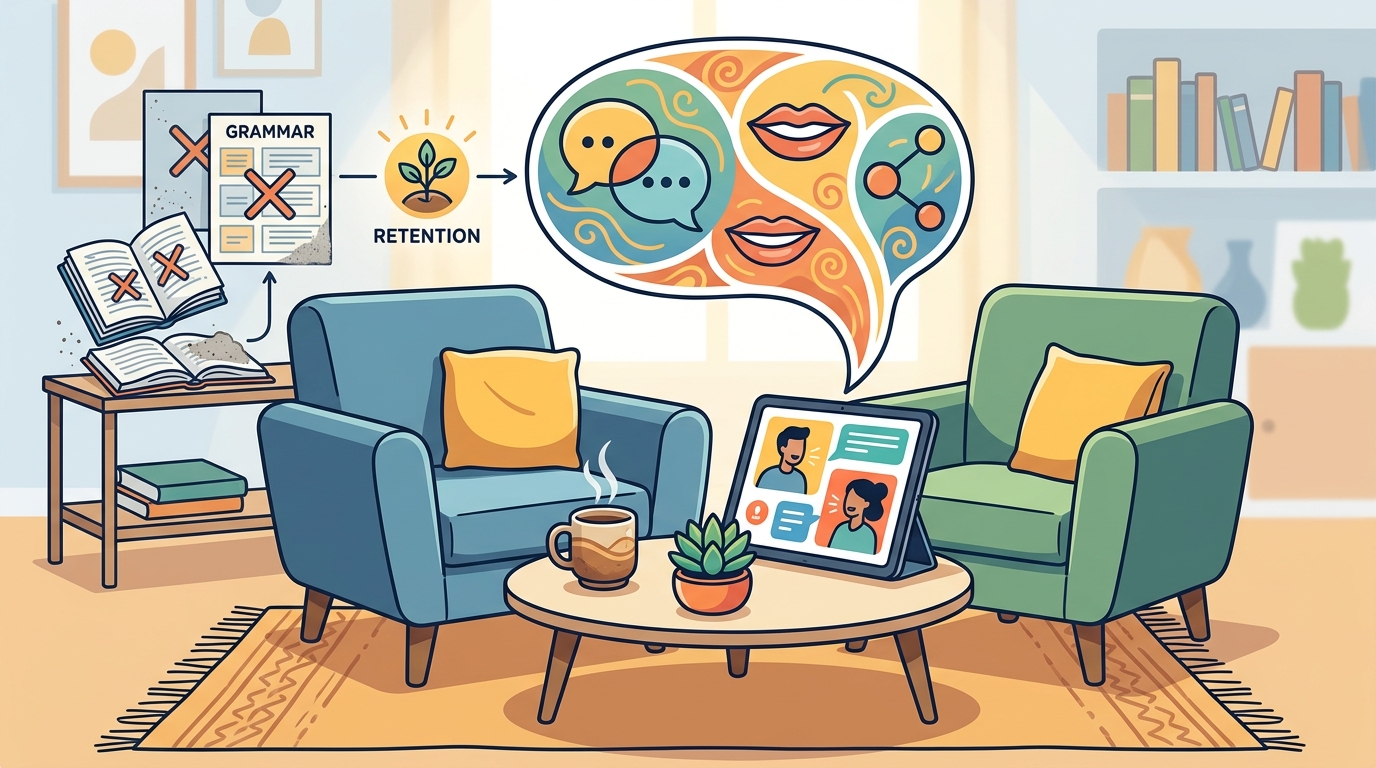
This is common, especially when learners associate speaking with being corrected, evaluated, or expected to sound perfect. A more productive approach is to practice in a relaxed environment where conversation comes first, mistakes are treated as useful information, and lessons are structured around active participation.
For more background on this teaching philosophy, visit About Pura Buena Onda. Pura Buena Onda has 19 years of experience helping learners practice conversational Spanish in a relaxed, fun, and non-judgmental online setting.
Why Comfort Matters When You Speak Spanish
Speaking a second language requires several mental tasks at once: remembering vocabulary, arranging words, listening for a response, interpreting meaning, and deciding what to say next. If you are also worried about embarrassment, your attention can shift away from communication and toward self-monitoring.
Research on second-language anxiety has found that emotional and social factors can influence how learners experience conversations, including how they evaluate their own performance and how comfortable they feel interacting with others. Supportive practice conditions can make it easier to participate and take communication risks. ([cambridge.org](https://www.cambridge.org/core/journals/studies-in-second-language-acquisition/article/second-language-anxiety-in-conversation-and-its-relationship-with-speakers-perceptions-of-the-interaction-and-their-social-networks/2799649938F7432AD14923C77CA8ACB4?utm_source=openai))
A relaxed Spanish environment does not mean that you avoid correction or challenge. It means the challenge is presented in a way that keeps you engaged. A teacher may recast an incorrect phrase, offer a more natural expression, or ask a follow-up question rather than interrupting every sentence. The goal is to help you communicate more effectively while keeping the conversation moving.
Explore additional Spanish-learning ideas on the Pura Buena Onda blog.
Start With Low-Pressure Speaking Tasks
If speaking Spanish feels intimidating, begin with tasks that have a clear purpose and a manageable length. You do not need to start by discussing complicated topics for an hour. Short, repeatable activities can help you become more comfortable producing Spanish aloud.
1. Describe what is around you
Choose five objects in your room and describe them in Spanish. For example:
- La mesa es de madera.
- Hay una taza azul.
- Mi computadora está junto a la ventana.
This activity helps you practice basic vocabulary, adjectives, location phrases, and sentence structure without requiring a conversation partner.
2. Give a one-minute update
Speak for one minute about your day. You might explain what you did in the morning, what you plan to do later, or something interesting you noticed. Repeat the same topic a second time and try to make one sentence clearer or more detailed.
3. Use familiar conversation themes
Prepare a short list of topics that you genuinely enjoy, such as food, travel, music, family traditions, books, exercise, or life in San Diego. Familiar interests reduce the amount of mental effort needed to invent content, leaving more attention for Spanish.
4. Practice useful communication strategies
Speaking confidently is not only about knowing more words. It also involves knowing how to keep a conversation going when you do not understand everything. Practice phrases such as:
- ¿Puedes repetirlo, por favor?
- ¿Qué significa esa palabra?
- Creo que quieres decir...
- No sé la palabra exacta, pero es algo que...
- Déjame pensarlo un momento.
These expressions give you time, invite clarification, and help you remain part of the conversation.
Choose a Practice Format That Fits You
The best speaking environment depends on your personality, current level, goals, and schedule. Some learners gain confidence from hearing several classmates speak. Others prefer a partner or need individualized support before participating in a group.
| Format | Group size | Best suited to | Main advantage |
|---|---|---|---|
| Online group class | 3–6 students | Learners who enjoy social interaction | Regular conversation with peer support |
| Semi-private class | 2 students | Learners who want focused practice with a partner | More individualized conversation while maintaining a social dynamic |
| Private lesson | 1 student | Learners with specific goals or speaking concerns | Personalized feedback and lesson content |
| Independent daily practice | Self-paced | Learners building consistency | Flexible repetition between lessons |
There is no universally correct choice. A beginner may enjoy a supportive group, while another beginner may prefer private instruction at first. An advanced learner may want conversation practice around professional, cultural, or personal interests. Language learning is highly individual, and progress depends on consistency, exposure, and opportunities to use Spanish.
Use Online Group Classes for Social Practice
Online group classes can recreate the energy of a friendly conversation while providing a clear learning structure. Pura Buena Onda’s online conversation classes use groups of 3 to 6 students, creating a social setting in which learners can listen to different voices, respond to questions, and exchange ideas.
In a group of five, each student might speak for approximately 10–20 minutes during a 90-minute lesson, depending on the activity and group dynamics. The value is not only the number of minutes spent talking. You also gain listening practice, exposure to different accents and communication styles, and experience following a conversation with more than one person.
Effective group activities may include:
- Sharing opinions about a current topic or personal experience
- Comparing cultural habits and traditions
- Role-playing a restaurant, travel, or workplace situation
- Retelling a short story in your own words
- Asking classmates follow-up questions
- Discussing a photo, video, or news item
Because the emphasis is conversational, students can focus on expressing meaning rather than waiting until every sentence is grammatically perfect. Teachers can guide the exchange, clarify vocabulary, and provide corrections that help learners sound more natural.
Try a Two-Student Semi-Private Class
A semi-private class with exactly two students offers a useful middle ground between group learning and individual instruction. You receive substantial opportunity to speak, but you are still practicing with another learner rather than carrying the entire conversation alone with a teacher.
This format can work well when two students share a goal. For example, partners may want to prepare for travel, practice professional conversations, discuss family topics, or improve their ability to tell stories in Spanish. The teacher can adapt the conversation to the students’ level and priorities while giving immediate, specific feedback.
A two-student setting may also feel safer for learners who are nervous about speaking in front of a larger group. You can experiment with longer answers, ask questions, and try new expressions without needing to perform for a large audience.
Use Private Lessons for Personal Goals
Private lessons provide the most individualized speaking practice. The teacher can devote the session to your specific needs, whether that means pronunciation, travel Spanish, workplace communication, conversation repair strategies, or preparation for an upcoming experience.
Private instruction may be especially helpful if:
- You understand Spanish but rarely speak it
- You feel blocked when conversations move quickly
- You want feedback on pronunciation or sentence formation
- You need to practice a particular professional or personal situation
- You prefer to build confidence before joining a group
- You want lessons organized around your interests
A private lesson should still feel like communication, not an oral examination. Ask your teacher to include realistic exchanges, follow-up questions, clarification requests, and unscripted moments. These elements help you prepare for the unpredictability of everyday conversation.
Build a Relaxed Daily Speaking Routine
Frequent, manageable practice is easier to maintain than occasional sessions that feel overwhelming. A practical routine might take 15–30 minutes and combine speaking with listening or review.
A 20-minute routine
- Three minutes: Review five useful words or phrases from a recent lesson.
- Five minutes: Listen to a short Spanish clip and repeat selected phrases.
- Seven minutes: Speak aloud about one familiar topic without reading a script.
- Five minutes: Record one sentence you want to improve and say it again more naturally.
Another option is to use a month-long challenge with varied activities. For example, a “30 for 30 in 30” structure can involve completing 30 Spanish tasks over 30 days, with about 30 minutes of practice on many days. Tasks might include sending a voice note, describing a recipe, listening to a podcast, answering a conversation prompt, or reviewing phrases from class.
The important principle is sustainability. If 30 minutes is not realistic on a particular day, shorten the activity rather than abandoning the habit. Consistency matters more than creating a perfect schedule.
Pura Buena Onda also offers online learning resources that incorporate conversation practice, including the Ser & Estar course, which includes online class time, homework, and conversation through voice notes.
Handle Mistakes Without Losing Momentum
Mistakes are part of speaking practice because they show you where your current language system is developing. The goal is not to eliminate every error before you speak. The goal is to communicate, notice patterns, and gradually make your Spanish more precise.
Separate communication from correction
After a conversation, identify one or two improvements instead of reviewing every imperfect sentence. You might notice that you need to work on past-tense endings, gender agreement, or a particular pronunciation pattern. A short focus list is easier to remember and apply.
Ask for the type of feedback you need
Tell your teacher whether you prefer immediate correction, notes during the conversation, or feedback at the end. Different learners benefit from different approaches, and a supportive teacher can adjust the lesson accordingly.
Measure progress by behavior
Instead of asking, “Did I speak perfectly?” ask:
- Did I answer in Spanish instead of switching languages?
- Did I ask for clarification when I needed it?
- Did I explain an idea using different words?
- Did I keep talking after making a mistake?
- Did I use a phrase from a previous lesson?
These are meaningful indicators of growing communication skills.
Follow a Simple Weekly Practice Plan
Here is a realistic structure for learners who want regular speaking practice without making Spanish feel like another full-time obligation:
- One online conversation class: Participate in guided discussion and listen to classmates.
- One short independent speaking session: Record a one- to three-minute response to a prompt.
- One review activity: Reuse vocabulary from class in new sentences.
- One low-pressure interaction: Send a Spanish voice note or respond to a learner conversation prompt.
- One reflection: Write down three expressions you want to use next week.
Students can request a schedule that fits their availability, and flexible scheduling options can make it easier to maintain a regular rhythm. The best plan is one you can continue while balancing work, family, travel, and other responsibilities.
Key Takeaways
- Speaking requires speaking: Grammar study and vocabulary review are useful, but they do not replace producing Spanish aloud.
- A relaxed setting supports participation: Lower-pressure interactions make it easier to take risks, ask questions, and continue after mistakes.
- Start with manageable tasks: One-minute updates, object descriptions, and familiar topics are effective entry points.
- Choose the right format: Online groups offer social practice, semi-private classes involve two students, and private lessons provide maximum personalization.
- Practice consistently: Short, repeatable routines are often easier to sustain than occasional intensive study.
- Use feedback strategically: Focus on a few high-value improvements instead of trying to correct every error at once.
- Expect individual progress: Many committed learners notice steady improvement over time, while reaching conversational confidence often requires sustained practice over a longer period, approximately two years for many learners depending on goals and consistency.
Frequently Asked Questions
How can I practice speaking Spanish if I feel embarrassed?
Begin with a supportive teacher, a trusted conversation partner, or a small online class. Use familiar topics and short speaking tasks, then gradually increase the length and complexity of your responses. A relaxed environment can make it easier to experiment without treating every mistake as a failure.
What is the best Spanish speaking practice for beginners?
Beginners often benefit from guided conversation with clear prompts, useful phrases, and gentle feedback. An online group of 3 to 6 students can provide social interaction, while a private lesson may be a better starting point if speaking anxiety feels especially strong.
Are online Spanish conversation classes effective?
Yes. Online classes can provide live interaction, guided speaking activities, correction, and regular accountability. Pura Buena Onda’s Spanish conversation classes are 100% online and held via Zoom, allowing learners to practice from a familiar setting.
How many students are in a semi-private Spanish class?
A semi-private class has two students. It offers more individualized speaking practice than a larger group while preserving the interaction of learning with a partner.
How often should I speak Spanish?
Aim for regular practice that fits your life. A weekly conversation class combined with several short speaking activities can create a sustainable routine. Daily practice is helpful when realistic, but consistency matters more than forcing a schedule you cannot maintain.
What should I do when I forget a Spanish word?
Keep communicating. Describe the idea in another way, ask ¿Cómo se dice...?, use a related word, or explain what the object or concept does. These strategies are valuable conversation skills, not signs that you have failed.
Can adults learn to speak Spanish in a relaxed environment?
Yes. Adults can benefit from conversation practice connected to their interests, experiences, travel plans, work, family, and daily routines. Progress depends on consistency, exposure, and practice rather than age alone.
Find a Comfortable Way to Start Speaking
You do not need to wait until your Spanish is perfect before using it. Start with a low-pressure task, join a conversation-focused class, or work with a teacher who can help you find the right level of challenge.
Pura Buena Onda offers 100% online conversational Spanish classes, semi-private classes for two students, private lessons, and online courses in a relaxed and encouraging environment. Contact Pura Buena Onda to discuss a learning option that fits your goals and availability.