

6-Step Plan to Overcome Speaking Anxiety in Conversational Spanish
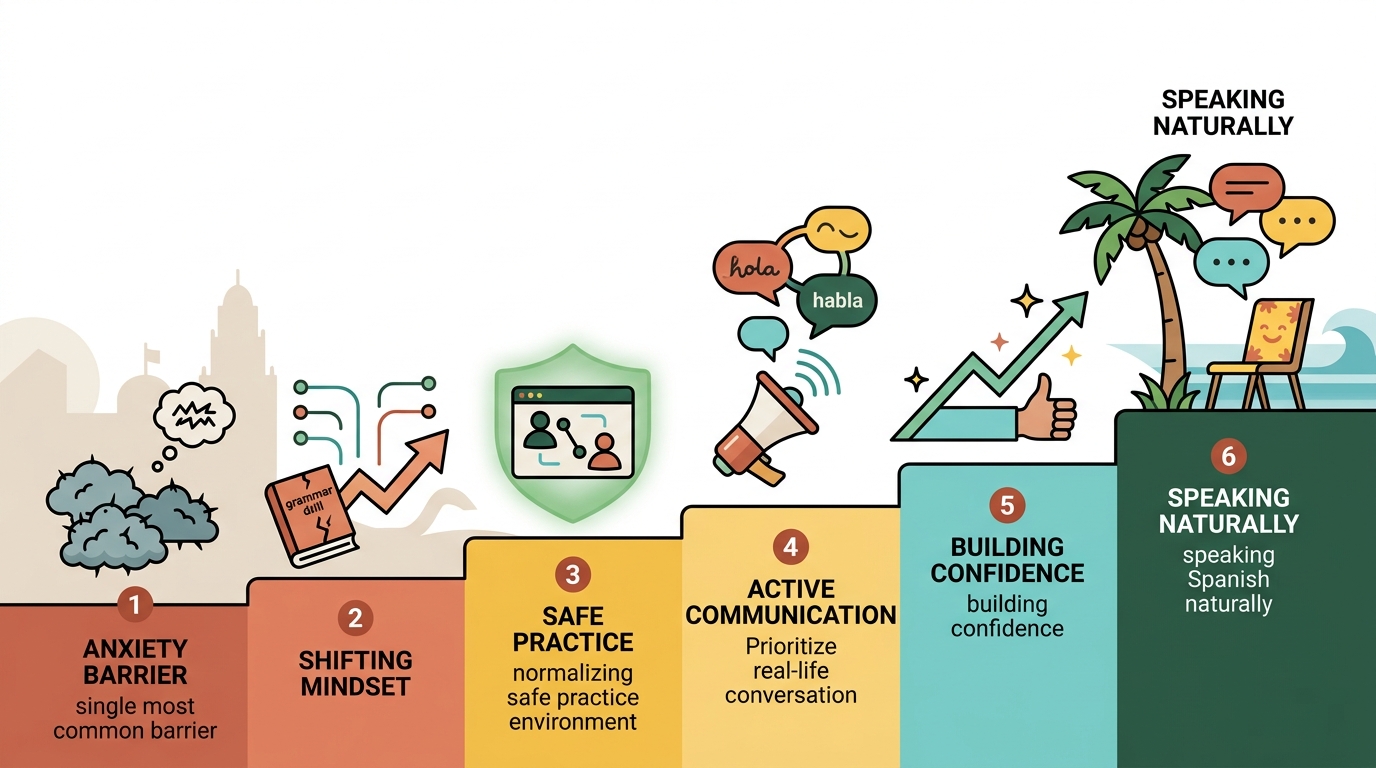
Speaking anxiety is the single most common barrier to language fluency, affecting nearly 80% of language learners at some point in their journey. This fear of judgment often stems from a lack of immediate, safe practice environments where mistakes are normalized. At Pura Buena Onda, we have spent 17 years dismantling this barrier by prioritizing real-life conversation over rigid grammar drills. This guide outlines six proven steps to shift your mindset from memorization to active communication, helping you build the confidence needed to speak Spanish naturally.
Step 1: Shift from Memorization to Interaction
Most learners fail because they treat language acquisition like an academic subject rather than a physical skill. You cannot learn to play tennis by reading books about tennis, and you cannot learn to speak Spanish by memorizing vocabulary lists. Language is a motor skill that requires physical production.
When you rely solely on apps or textbooks, you are building passive knowledge. This creates a gap between what you know and what you can say, leading to anxiety when you finally attempt to speak. To overcome this, you must start producing language immediately, even if it is imperfect. This approach aligns with the concept of comprehensible output, which is the process of generating language that is slightly beyond your current level of competence.
By engaging in live conversation early, you force your brain to retrieve words under pressure, which strengthens neural pathways faster than passive review. This method is central to our curriculum, which focuses on small-group Spanish classes designed to maximize speaking time for every student.
Step 2: Embrace the "Happy Hour" Mindset
Anxiety thrives in formal, high-pressure environments. To counter this, you must reframe your learning sessions as social interactions rather than tests. The phrase "pura buena onda" translates to a relaxed, positive connection between people, which is the exact atmosphere required for effective learning.
When you view a class as a casual hangout with friends, the stakes are lowered. You are not there to be graded; you are there to share stories, laugh at mistakes, and connect. This psychological shift reduces cortisol levels, which are known to inhibit memory recall and speech production. Psychological research confirms that a relaxed state is optimal for language acquisition.
We encourage students to bring their authentic selves to class. Whether you are discussing your latest road trip or complaining about your in-laws, the content matters less than the act of speaking. This approach ensures that you are learning vocabulary that is immediately relevant to your life, making it easier to recall during real-world interactions.
Step 3: Leverage Small-Group Dynamics
Speaking in front of a large audience is terrifying, but speaking in a small group is manageable. Small classes allow for personalized attention and ensure that every student gets significant speaking time. In a typical large class, you might speak for two minutes a week. In a small group, you might speak for twenty minutes.
This increased exposure desensitizes you to the fear of speaking. You begin to realize that your peers are also struggling, which creates a sense of camaraderie and reduces the feeling of isolation. Semi-private Spanish classes offer a balanced environment where you can practice with a partner while still benefiting from group dynamics.
Furthermore, small groups allow instructors to provide immediate, targeted feedback. This real-time guidance helps you correct errors before they become habits, boosting your confidence in your own abilities. The supportive nature of these groups is a key factor in our teacher-student relationship, which is built on trust and mutual respect.
Step 4: Utilize Daily Micro-Practice
Consistency is more important than intensity. Trying to cram hours of study once a week is ineffective for building speaking confidence. Instead, engage in daily micro-practice sessions that last only 10 to 15 minutes. This could involve responding to a daily conversation prompt on social media or speaking to yourself in the mirror.
Daily practice keeps the language active in your mind, reducing the cognitive load required to retrieve words during a conversation. This method is particularly effective for overcoming the "frozen" feeling that often occurs when you haven't spoken Spanish in days. Our Patreon community provides daily prompts and resources to facilitate this kind of consistent engagement.
By integrating Spanish into your daily routine, you normalize the language. It becomes a part of your life rather than a separate, intimidating task. This gradual integration helps to build a sustainable habit that supports long-term fluency.
Step 5: Seek Real-Time Correction
Many learners avoid speaking because they fear making mistakes. However, mistakes are essential for learning. The key is to receive correction in a supportive, immediate manner. Real-time correction helps you understand the nuance of the language and prevents fossilization of errors.
In a conversational setting, corrections should be gentle and contextual. Instead of stopping the flow of conversation to explain a grammar rule, a skilled instructor will model the correct form naturally. This approach maintains the momentum of the conversation while still addressing the error. Language teaching experts recommend recasting as a primary correction technique.
Knowing that you have a safety net of supportive instructors allows you to take risks. You are more likely to try complex sentences or new vocabulary if you know that help is available. This risk-taking is crucial for advancing beyond the intermediate plateau.
Step 6: Commit to a Structured Challenge
Breaking through a plateau often requires a dedicated period of intense focus. A structured challenge, such as a bootcamp, provides the accountability and community support needed to push through anxiety. These programs typically combine daily practice, weekly classes, and social events to create an immersive experience.
The 90-Day Spanish Bootcamp is designed to help students advance a level or feel noticeably more confident in just three months. The daily tasks, such as responding to conversation questions and engaging with social media content, ensure that you are constantly practicing.
Accountability is a powerful tool. Knowing that you will report your progress to a group of peers motivates you to show up, even when you feel anxious. The social events, both in-person and online, further reinforce the community aspect, making the learning process enjoyable and sustainable.
Comparison of Learning Environments
Choosing the right environment is critical for overcoming anxiety. The table below compares different learning options based on speaking time, correction style, and social support.
| Learning Method | Daily Speaking Time | Correction Style | Social Support |
|---|---|---|---|
| Online Classes | High | Real-time, contextual | Strong community |
| Language Apps | Low | Automated, delayed | Minimal |
| Private Tutoring | Very High | Personalized, immediate | One-on-one |
| Bootcamps | Very High | Group and individual | Intense accountability |
Key Takeaways
- 17 Years of Experience: Pura Buena Onda has been helping students overcome speaking anxiety since 2007, establishing a proven methodology for success.
- 8 Proficiency Levels: Our structured levels ensure you are never placed in a class that is too advanced or too basic, reducing performance anxiety.
- Daily Engagement: Our social media prompts and Patreon content provide the daily micro-practice necessary to keep Spanish active in your mind.
- Real-Time Feedback: Native speaking teachers provide immediate corrections, which is critical for accurate language production.
- Community Focus: Our social club events and group classes create a supportive environment that normalizes mistakes and encourages risk-taking.
- Flexible Scheduling: We offer numerous class options each week, allowing you to fit learning into your life without added stress.
- Proven Results: Students in our bootcamps typically advance a level or report significantly increased confidence within 90 days.
Frequently Asked Questions
How long does it take to overcome speaking anxiety?
There is no fixed timeline, as it depends on individual comfort levels and practice frequency. However, most students report a significant reduction in anxiety after 4 to 6 weeks of consistent conversational practice. The key is to start speaking immediately rather than waiting until you feel "ready," which may never come.
Is it better to take private or group classes for anxiety?
Both have benefits. Private classes offer maximum speaking time and personalized attention, which can be less intimidating for some. Group classes provide a sense of community and normalize the experience of making mistakes, which can be empowering. Many students start with private sessions and transition to groups as their confidence grows.
What is the "Happy Hour" mindset?
The "Happy Hour" mindset refers to approaching language learning as a social, enjoyable activity rather than a rigorous academic task. It involves letting go of perfectionism and focusing on connection and communication. This approach reduces pressure and makes learning more sustainable.
Do you offer classes for complete beginners?
Yes, we have eight levels ranging from absolute beginner to advanced. Our curriculum is designed to build confidence gradually, ensuring that even complete beginners feel supported and understood from day one.
How does the 90-Day Bootcamp help with anxiety?
The bootcamp provides a structured, daily routine that eliminates decision fatigue. The daily tasks and weekly accountability create a supportive pressure that pushes you to practice consistently. The community aspect ensures you are never practicing alone, which reduces the fear of judgment.
Can I attend classes online if I live outside San Diego?
Absolutely. Our online classes are conducted via Zoom and are just as effective as in-person sessions. We have students from all over the world who benefit from our conversational approach and supportive community.
What is the role of grammar in your classes?
Grammar is taught in context, not in isolation. We focus on how grammar functions in real conversation, which helps you understand when and why to use specific structures. This approach is more practical and less intimidating than traditional grammar drills.
Start Your Journey to Confident Speaking
Overcoming speaking anxiety is not about eliminating fear; it is about acting despite it. By following these six steps and immersing yourself in a supportive community, you can transform your relationship with the Spanish language. Join us at Pura Buena Onda and discover the joy of real conversation. Schedule a free consultation today to find the perfect class for your needs.