

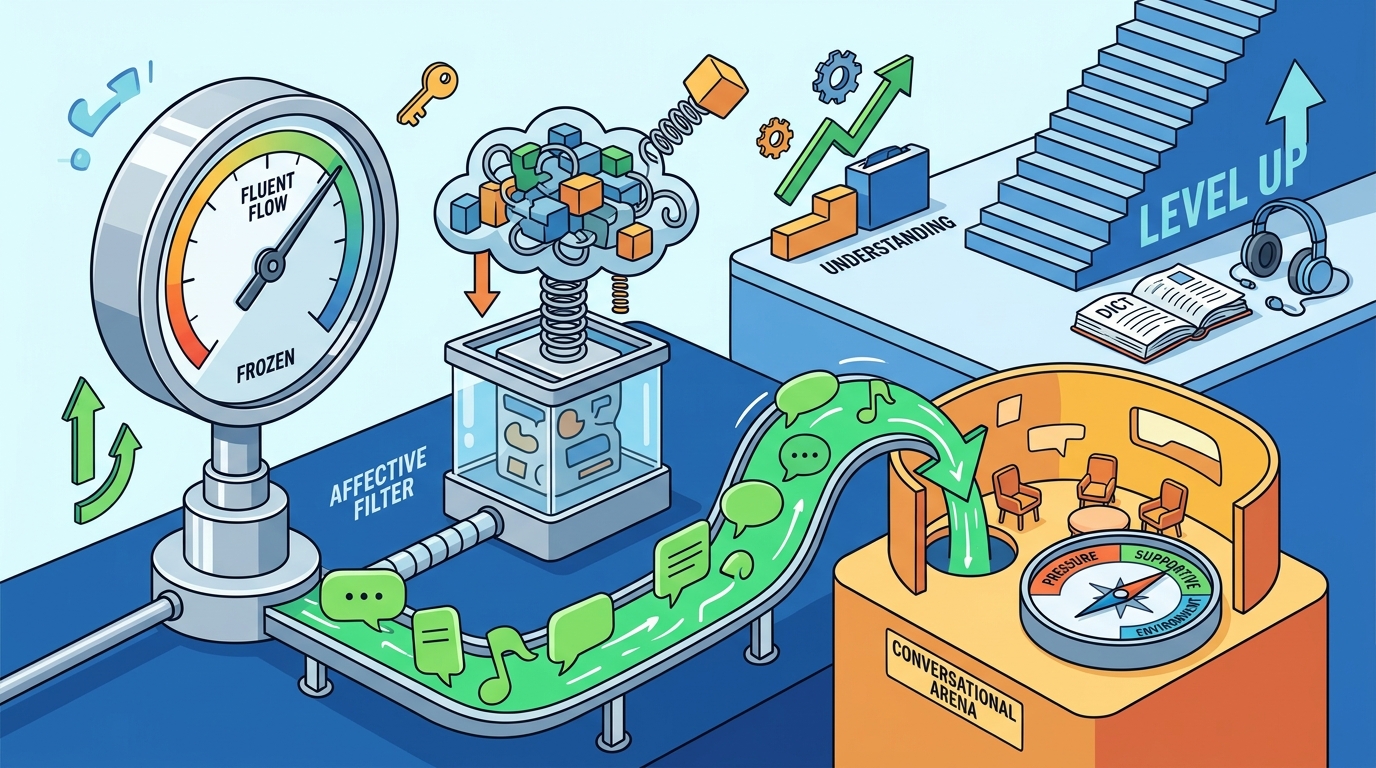
Most adult learners reach a frustrating plateau where they understand Spanish perfectly but freeze when asked to speak. This phenomenon is not a lack of intelligence but a psychological barrier known as the "affective filter." When anxiety rises, the brain blocks language production. According to recent linguistic studies on second language acquisition, creating a low-stakes environment is the single most effective way to lower this filter and restore fluency. This guide details the exact steps to transition from passive understanding to active, confident speaking without the fear of judgment.
Why Traditional Apps Fail at Building Confidence
Language learning applications have democratized access to vocabulary, but they often fail to teach the mechanics of conversation. App-based learning is a passive activity that simulates language through multiple-choice questions rather than requiring active production. You might know the word for "apple," but you do not know how to ask for directions to the market using that word.
When you attempt to speak without prior practice in a social context, you encounter the "silent period" backlash. This is where the brain refuses to output data because it lacks the confidence that the output will be correct. Research indicates that learners who rely solely on digital tools often experience higher anxiety levels when interacting with native speakers compared to those who practice in small groups. The gap between knowing grammar rules and using them in real-time is where confidence dies.
To bridge this gap, you must shift from memorization to interaction. This requires a structured approach that prioritizes safety and repetition over speed. The following steps outline a proven methodology for rebuilding your speaking muscles in a supportive setting.
Step 1: Curate a Zero-Judgment Environment
The first step to building confidence is removing the fear of embarrassment. In a traditional classroom or a large group setting, the fear of making mistakes in front of peers can paralyze your speech. A low-pressure environment is defined by its lack of punitive correction and its emphasis on communication over perfection.
Look for a community that explicitly states that mistakes are part of the learning process. Confidence is built in safety, not in high-stakes testing scenarios. When you know that your teacher and peers are there to support you rather than judge you, your brain relaxes. This relaxation allows you to access your passive vocabulary and convert it into active speech.
At Pura Buena Onda, we have spent 17 years perfecting this specific environment. We call it "pura buena onda," which translates to a pure, positive vibe. This is not just a marketing slogan. It is a pedagogical strategy. By ensuring that every student is at a similar level and that the atmosphere is relaxed, we eliminate the social anxiety that typically blocks language acquisition.
Step 2: Establish a Micro-Habit Routine
Confidence is not a trait you are born with; it is a skill you build through repetition. However, attempting to study for three hours once a week is ineffective. The brain requires frequent, short bursts of engagement to retain language patterns. This is where the concept of a "micro-habit" becomes critical.
Commit to speaking Spanish for just 10 to 15 minutes every day. This does not mean studying grammar. It means engaging in low-stakes interaction. You might respond to a daily conversation prompt on social media, record yourself speaking for two minutes, or chat with a partner. The goal is consistency, not intensity.
Our 90-Day Spanish Bootcamp utilizes this exact principle. Participants are required to engage with daily tasks, such as responding to a "Conversation of the Day" prompt. This daily requirement forces you to produce language regularly, which normalizes the act of speaking. Over time, the anxiety associated with daily output diminishes because the brain becomes accustomed to the routine.
Step 3: Implement Real-Time Correction
One of the biggest misconceptions about low-pressure learning is that it means no correction. This is false. To build confidence, you must know what you are doing wrong. However, the *timing* and *method* of correction matter immensely.
In a high-pressure environment, a teacher might stop you mid-sentence to correct a grammar error. This breaks your flow and increases anxiety. In a low-pressure conversational class, the teacher listens for meaning first. They allow you to finish your thought. Afterward, they provide gentle, targeted feedback on the most impactful errors.
This method is known as "recasting." The teacher repeats your sentence back to you in the correct form without explicitly shaming you. For example, if you say "I go to the store yesterday," the teacher might respond, "Ah, you went to the store yesterday? That sounds fun." This reinforces the correct grammar while maintaining the flow of conversation. This approach builds confidence because you learn the correct form without feeling defeated.
Step 4: Leverage Social Immersion
Speaking Spanish in a classroom is different from speaking it in a social setting. To truly build confidence, you must eventually bridge the gap between structured class and casual interaction. This is where social immersion comes in.
Joining a social club or attending in-person events allows you to practice Spanish in a relaxed, non-academic context. Whether it is a dinner party or a casual meetup, the focus shifts from "learning" to "connecting." When the goal is connection, the fear of grammar errors fades. You become more interested in being understood than in being perfect.
Our monthly social events, held both in-person in San Diego and online via Zoom, provide this exact opportunity. These events are designed to be fun and low-pressure. You are not tested. You are simply encouraged to use the language you have been practicing in class. This reinforces the utility of your skills and proves to yourself that you can communicate effectively.
Comparison of Learning Modalities
Understanding the differences between learning methods helps you choose the right path for building confidence. The table below compares the primary modalities available to adult learners.
| Modality | Pressure Level | Correction Style | Confidence Building Speed |
|---|---|---|---|
| App-Based Learning | Low (Private) | Instant/Digital | Slow (Passive) |
| Large Group Class | High (Public) | Interruptive | Slow (Anxiety-Inducing) |
| Semi-Private Class | Medium | Gentle/Post-Speech | Moderate |
| Private Tutoring | Low (Personalized) | Customized | Fast (Tailored) |
| Bootcamp Program | Medium (Structured) | Real-Time Support | Very Fast (High Frequency) |
Key Takeaways
- Environment Matters: A zero-judgment space is the foundation of speaking confidence.
- Consistency Over Intensity: Daily micro-habits build neural pathways faster than weekly cramming.
- Correction Timing: Post-speech feedback preserves flow and reduces anxiety.
- Social Application: Real-world events prove your ability to communicate effectively.
- Community Support: Learning with peers at your level reduces the fear of standing out.
- Historical Proof: Pura Buena Onda has maintained this methodology for over 17 years.
- Active Production: You cannot learn to speak by listening alone; you must speak.
Frequently Asked Questions
How long does it take to build speaking confidence?
Confidence is subjective, but most students report feeling significantly more comfortable after 8 to 12 weeks of consistent practice. The 90-Day Bootcamp is designed specifically to accelerate this timeline through daily engagement.
Do I need to be fluent to join a low-pressure class?
No. These classes are designed for all levels, from absolute beginners to advanced speakers. The goal is communication, not perfection. You will be grouped with others at your level to ensure comfort.
What is the difference between a semi-private and a small-group class?
Semi-private classes typically involve one or two other students, allowing for maximum speaking time per person. Small-group classes may have up to six students, offering more diverse conversation partners while still maintaining a manageable size.
Can I take these classes online?
Yes. Online classes via Zoom offer the same low-pressure environment as in-person classes. You can practice from the comfort of your home, which often reduces social anxiety for many learners.
What if I miss a class?
Flexibility is key to maintaining confidence. Most programs, including ours, allow you to join different sessions throughout the week. Life happens, and a supportive environment will never guilt-trip you for missing a session.
Is grammar taught in these classes?
Grammar is taught implicitly through correction and context. Explicit grammar drills are often removed to keep the focus on speaking. You learn the rules by using them in real conversations.
How do I handle the fear of making mistakes?
Embrace the mistake. In a low-pressure environment, mistakes are viewed as data points for improvement. Every error you make and correct is a step toward fluency. Our teachers are trained to help you reframe mistakes as learning opportunities.
Start Your Journey
Building Spanish speaking confidence is not about waiting until you feel ready. It is about creating the conditions where you can practice safely and consistently. By following these steps and joining a supportive community, you will break through your plateau and discover the joy of real conversation.
Ready to stop memorizing and start speaking? Contact us today to schedule a free consultation or view our 2026 class schedule. Join the thousands of students who have found their voice with Pura Buena Onda.