

Duolingo vs. Real Conversation: The Best Spanish Alternative for Adults
Ask any adult who's used a language app for six months whether they can hold a five-minute conversation, and most will say no. That disconnect isn't about effort or aptitude — it's about what the app is actually training. Recognizing "el perro" in a multiple-choice grid is a different skill than reaching for it mid-sentence while someone's looking at you, waiting to respond. Closing that gap requires speaking practice, not more screen time.The Limits of Gamified Learning
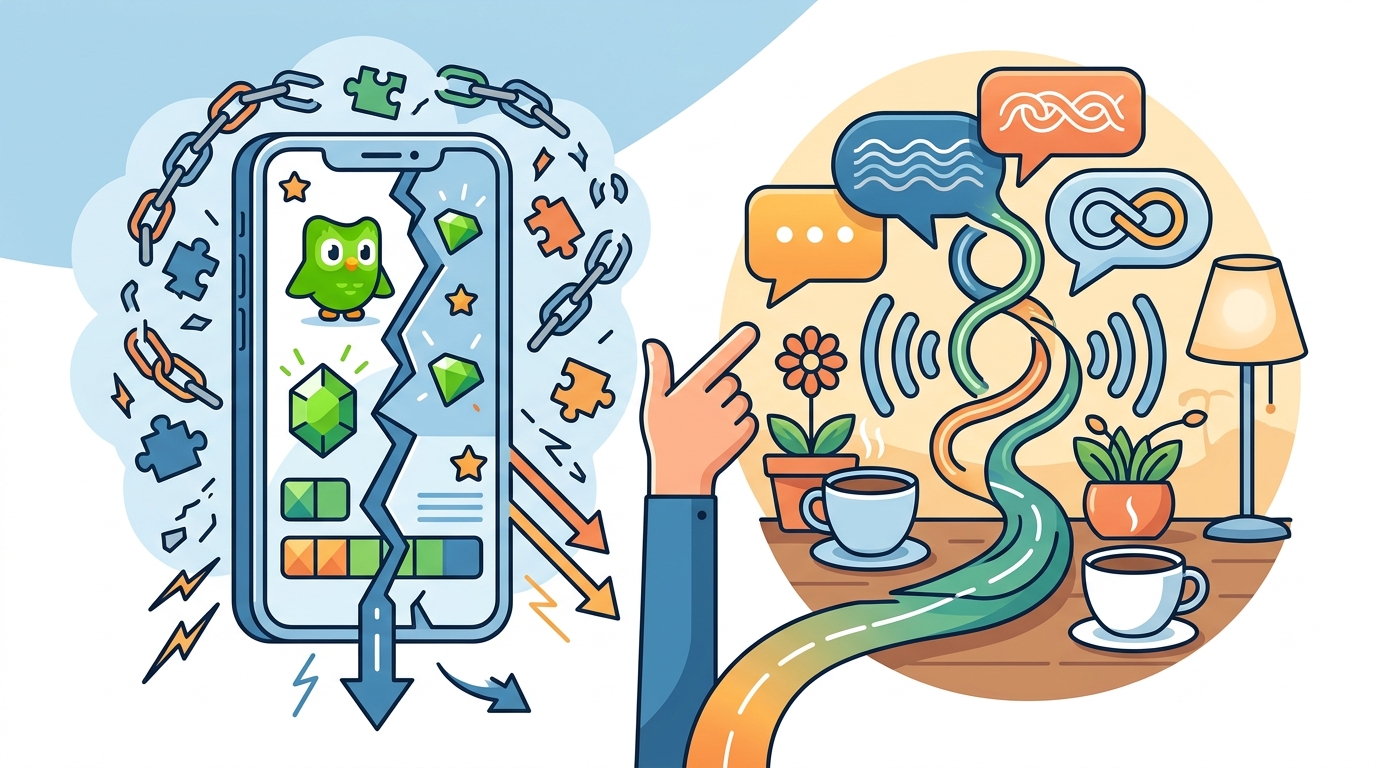
Apps like Duolingo have democratized access to language basics, but they are not designed for fluency. These platforms rely on spaced repetition and gamification loops to keep users engaged. While this works for recognizing words, it does not teach you how to construct sentences under pressure. You might know the word for "apple," but you will likely freeze when trying to order coffee in Mexico City.
Language acquisition requires output, not just input. When you only tap buttons on a screen, you are training your eyes, not your mouth. This creates a false sense of competence. You feel like you are learning because you see your streak growing, but you are not building the muscle memory needed for real-time dialogue. This is why many adults feel stuck at an intermediate plateau despite years of app usage.
To break through this barrier, you need a different approach. You need to speak with other humans who can correct you in real time. This is the core philosophy behind Pura Buena Onda, which has been helping students achieve fluency for over 17 years. The difference is not just in the method, but in the environment. Learning should feel like a conversation, not a test.
Why Real Conversation Matters
Fluency is not about memorizing grammar rules. It is about developing the ability to think in a new language. When you speak with a native speaker, you learn the rhythm, tone, and cultural nuances that apps simply cannot teach. According to research published in the Frontiers in Psychology, social interaction is a critical component of successful second language acquisition.
Real conversation allows you to make mistakes in a safe space. In a classroom or online group, you can try out new phrases without fear of judgment. This psychological safety is essential for adult learners who often feel embarrassed about their accent or grammar. At Pura Buena Onda, we prioritize a relaxed, non-intimidating environment where mistakes are viewed as learning opportunities.
Furthermore, real conversation exposes you to different accents and speeds. Apps usually use standardized, slow-paced audio. In the real world, people speak quickly and with varied intonation. By practicing with native speakers from different countries, you prepare yourself for actual travel or business interactions. This is a skill that no algorithm can replicate.
Small-Group Classes
For many adults, small-group classes offer the best balance of structure and social interaction. These sessions typically involve three to six students, allowing for ample speaking time for each participant. The group dynamic creates a sense of community and accountability that is hard to find in solo app usage.
In a small-group setting, you learn from others as well as the teacher. You hear different perspectives and practice responding to various speaking styles. This mirrors real-life social interactions more closely than one-on-one tutoring. Small-group Spanish classes are designed to be fun and engaging, often focusing on topics that are relevant to your life.
The flexibility of these classes is another major advantage. You can join sessions that fit your schedule, whether you prefer mornings or evenings. This makes it easier to maintain consistency, which is key to language learning. With 2026 group class schedules available online, you can plan your learning journey well in advance.
Semi-Private Sessions
Semi-private classes are ideal for those who want more personalized attention but still enjoy the energy of a partner. These sessions usually involve two students and last for 60 minutes. This format allows the teacher to tailor the lesson to the specific needs and goals of both participants.
Learning with a partner can be highly motivating. You can compete in a friendly way, quiz each other, and practice role-playing scenarios. This is particularly effective for couples or friends who want to learn together. Semi-private Spanish classes offer a cost-effective way to get more individualized instruction than a large group.
The focus in these sessions is often on practical communication. You might practice ordering food, asking for directions, or discussing current events. This immediate applicability keeps learners engaged and motivated. The teacher provides real-time feedback, helping you correct errors before they become habits.
Private Tutoring
Private tutoring offers the highest level of customization and intensity. With one-on-one sessions, the entire 60 minutes is dedicated to your specific goals. This is the fastest way to progress if you have a tight schedule or specific needs, such as preparing for a business trip.
In private sessions, you can move at your own pace. If you struggle with a particular grammar point, you can spend extra time on it. If you are already proficient in another area, you can skip ahead. Private Spanish classes allow for this level of control, which is rarely possible in group settings.
The relationship with your tutor can also be deeply supportive. They can help you overcome mental blocks and build confidence. This personal connection is often the missing link for adults who have struggled with self-study. By working directly with an experienced instructor, you gain insights into the language that go beyond textbook rules.
The Bootcamp Accelerator
For those who need a significant boost, the 90-Day Spanish Bootcamp provides an intensive immersion experience. This program combines daily practice, weekly accountability, and community support to accelerate your learning. It is designed for students who are ready to commit to a rigorous schedule.
The bootcamp requires daily engagement, including responding to conversation prompts and attending weekly classes. This consistency helps build a strong habit loop. According to studies on habit formation, it takes approximately 66 days on average to form a new habit. A 90-day program ensures that you have enough time to solidify your new routine.
Participants also attend monthly social events, which provide opportunities to practice in real-world settings. These events range from in-person gatherings in San Diego to online meetups for international students. The combination of structured learning and social interaction creates a powerful learning ecosystem. This is far more effective than sporadic app usage.
Comparison Summary
| Learning Method | Interaction Level | Best For | Fluency Potential |
|---|---|---|---|
| Duolingo | Low (App-based) | Beginners/Vocabulary | Low |
| Small-Group Classes | Medium (3-6 Students) | Social Learners | High |
| Semi-Private | Medium-High (2 Students) | Partners/Friends | High |
| Private Tutoring | High (1-on-1) | Busy Professionals | Very High |
| 90-Day Bootcamp | Very High (Daily) | Committed Learners | Very High |
Key Takeaways
- Apps like Duolingo focus on input, while fluency requires active output and conversation.
- Pura Buena Onda has been operating for over 17 years, providing a proven alternative to digital apps.
- Small-group classes offer a balance of social interaction and structured learning.
- Semi-private sessions are ideal for personalized attention with a partner.
- Private tutoring allows for complete customization of your learning pace and goals.
- The 90-Day Bootcamp provides intensive daily practice for rapid progress.
- Real conversation exposes you to native accents and cultural nuances.
Frequently Asked Questions
Is Duolingo good for learning Spanish?
Duolingo is effective for building initial vocabulary and familiarity with the language. However, it is not sufficient for achieving fluency because it lacks real-time conversation practice.
How long does it take to become fluent in Spanish?
Fluency timelines vary based on intensity and method. With daily practice and conversation immersion, many students see significant progress within 3 to 6 months.
What is the difference between small-group and semi-private classes?
Small-group classes involve 3 to 6 students, offering more social interaction. Semi-private classes involve only two students, providing more individualized attention.
Can I take classes online?
Yes, online classes are conducted via Zoom, allowing students from anywhere to participate in live conversation sessions.
What is the PBO 90-Day Bootcamp?
The bootcamp is an intensive program that combines daily tasks, weekly classes, and monthly events to accelerate language learning over a 90-day period.
Do you offer classes for beginners?
Yes, we offer levels from A1 to A2 for beginners, ensuring you start with the right foundation for conversation.
How do I sign up for a class?
You can sign up by visiting our contact page or booking a free consultation to discuss your goals.
Start Speaking Today
Stop letting apps dictate your language journey. Real fluency happens when you step into the conversation. Join Pura Buena Onda today and experience the difference that real human connection makes in learning Spanish. Book your free consultation now and take the first step toward confidence.