

Duolingo can be a convenient way to begin Spanish. You can open the app during a commute, complete a short lesson, review vocabulary, and build a regular study habit. But many adults eventually notice a frustrating gap: they recognize more Spanish than they can actually use.
You may know how to translate a sentence on a screen yet hesitate when someone asks ¿Cómo estuvo tu fin de semana? You may remember vocabulary for food, travel, and family but struggle to explain what happened at work, tell a story, or follow a Spanish-speaking friend who answers quickly.
That is why the better alternative to Duolingo for many adult learners is not necessarily another app. It is a learning environment built around live conversation, useful feedback, cultural context, and consistent human interaction.
Pura Buena Onda has spent 19 years helping adults learn Spanish through conversational instruction. All classes are 100% online, and the school offers private, semi-private, and small-group conversation classes in a relaxed, supportive environment. Learn more about Pura Buena Onda.
The Short Answer: Use Duolingo as a Supplement, Not Your Entire Spanish Plan
Duolingo is useful for introducing vocabulary, reviewing basic structures, practicing reading, and creating a daily habit. Its Spanish course includes activities involving reading, listening, writing, and speaking, along with features such as stories, audio content, reminders, and social motivation tools. ([blog.duolingo.com](https://blog.duolingo.com/duolingo-101-how-to-learn-a-language-on-duolingo/?utm_source=openai))
However, an app is not the same as participating in an unpredictable conversation with another person. A real conversation requires you to understand a question, select words quickly, adapt when you do not know a term, interpret tone, and respond to something you did not anticipate.
For that reason, the most effective alternative for an adult who wants to speak Spanish with greater confidence is often a conversation-focused class. You can continue using Duolingo for review while adding the element the app cannot fully recreate: regular, guided interaction with a teacher and classmates.
What Duolingo Does Well for Adult Spanish Learners
A fair comparison should acknowledge the strengths of language apps. Duolingo may be a good fit when you want:
- A low-barrier starting point: You can begin with short lessons without arranging a class or committing to a fixed program.
- Vocabulary exposure: Repeated encounters with common words and phrases can help you build an initial foundation.
- Convenient review: An app can be helpful when you have five or ten minutes available between other responsibilities.
- Habit support: Reminders, points, progress indicators, and short activities can encourage regular contact with Spanish.
- Basic reading and listening practice: Structured exercises give beginners a way to become familiar with the sound and appearance of Spanish.
The issue is not that Duolingo is useless. The issue is that adult learners often expect one tool to produce every kind of ability: vocabulary recognition, pronunciation, listening comprehension, spontaneous speaking, cultural awareness, and conversational confidence. No single resource is ideal for all of those goals.
Duolingo itself describes its courses as covering multiple skills and communication goals, and the company continues to add AI-supported speaking features. That makes the app more useful for practice than a simple flashcard system, but app-based interaction still differs from a live exchange with a human teacher or conversation partner. ([blog.duolingo.com](https://blog.duolingo.com/duolingo-101-how-to-learn-a-language-on-duolingo/?utm_source=openai))
Where App-Based Spanish Study Often Stops
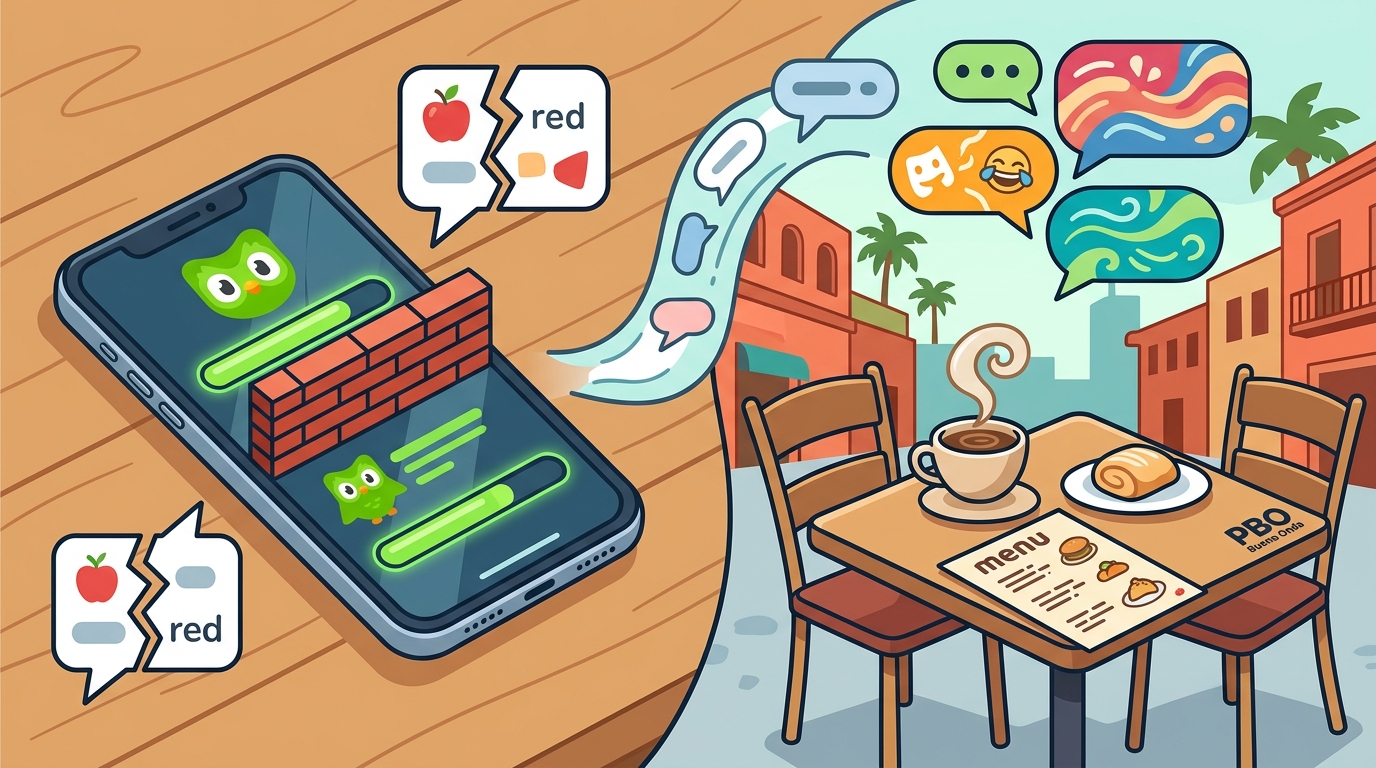
1. Recognition is easier than spontaneous production
On an app, you usually receive a clear prompt and a limited set of possible answers. In a conversation, you must create language from your own thoughts. That difference matters.
For example, an exercise may ask you to translate “I need to make a reservation.” A real conversation may require you to say:
- Quiero reservar una mesa para cuatro personas.
- ¿Tienen disponibilidad el sábado por la noche?
- Mi amigo es alérgico a los mariscos.
These sentences involve the same broad topic, but they require flexible vocabulary, pronunciation, grammar, and the ability to react to a response.
2. Automated correction cannot explain every communication choice
An automated exercise can identify whether your answer matches an expected response. A teacher can help you understand why one phrase sounds more natural, whether a word is appropriate in a particular country, or how your tone changes the meaning.
For adult learners, this contextual feedback is especially valuable. You may need to distinguish between a grammatically possible sentence and the expression a native speaker would normally choose in a restaurant, workplace, neighborhood, or family conversation.
3. Apps do not create the same social pressure as human interaction
Speaking to a screen can be useful preparation, but it does not fully reproduce the listening demands of a real person. Human conversation includes pauses, interruptions, reformulations, regional accents, humor, emotion, and unexpected follow-up questions.
Peer interaction can also contribute to learning because students must listen, interpret, respond, and notice how another learner expresses an idea. Research on peer interaction and collaborative learning describes ways that interaction can support questioning, participation, and learning processes. ([apa.org](https://www.apa.org/pubs/journals/features/edu-edu0000436.pdf?utm_source=openai))
4. A streak does not automatically equal communication ability
A daily streak measures consistency with an app. It does not tell you whether you can order breakfast, describe a problem, make small talk, or keep a conversation going when you forget a word.
Consistency remains important, but the activity must also match your goal. If your goal is conversation, your routine needs regular opportunities to listen and speak in conversation.
Why Live Conversation Is a Stronger Alternative for Many Adults
A conversation-first program makes speaking part of the learning process rather than something postponed until you have mastered enough grammar or vocabulary.
Speaking becomes the central practice
At Pura Buena Onda, lessons are designed around organic conversation and active participation. Topics can connect to daily life, travel, work, relationships, family, food, hobbies, and current experiences. Instead of only selecting a correct answer, you practice constructing your own thoughts.
A beginner might practice answering a simple question about their day. An intermediate learner might describe a disagreement at work, compare two travel experiences, or explain an opinion. An advanced learner might discuss cultural differences, tell a detailed story, or debate a topic with appropriate nuance.
Feedback arrives while the language is still meaningful
When a teacher hears your Spanish in context, feedback can address more than a single error. You can work on pronunciation, word choice, verb forms, sentence flow, and strategies for communicating around a word you do not know.
Good correction should help you communicate more clearly without making you afraid to speak. Pura Buena Onda emphasizes a relaxed and non-intimidating environment where mistakes are treated as a normal part of learning.
You hear different voices and communication styles
Listening to a teacher and classmates exposes you to more than one rhythm or accent. Pura Buena Onda’s teaching team includes instructors from different parts of Latin America and Spain, giving students opportunities to encounter varied Spanish and cultural perspectives. ([purabuenaonda.com](https://purabuenaonda.com/about/teachers/?utm_source=openai))
You learn language in context
Spanish is not only a collection of conjugations and vocabulary items. Meaning can depend on region, relationship, formality, tone, idioms, and cultural expectations. A conversation-focused teacher can explain those differences as they arise.
For instance, knowing the dictionary translation of qué onda does not automatically tell you where the expression is common, how informal it is, or whether it fits the situation. Context helps transform memorized language into usable language.
Pura Buena Onda Class Options for Adult Learners
Pura Buena Onda offers 100% online Spanish instruction for learners at different levels and with different goals. Students can request a schedule that fits their availability, and flexible scheduling options are available.
Small-group conversation classes
Small-group classes include 3 to 6 students and are designed to provide a supportive social setting for practicing Spanish. The group format lets you listen to different speakers, respond to classmates, and participate in conversations that feel more varied than one-way practice. In a group of five, a student might speak for approximately 10–20 minutes during a session, depending on the lesson and group dynamics.
Semi-private classes
Semi-private classes consist of two students only. This option can work well for friends, partners, or family members who want to learn together while receiving more focused interaction than a larger group provides. Students can practice situations such as making plans, handling a travel problem, preparing for a professional conversation, or discussing a personal interest.
Private Spanish classes
Private classes are one-on-one sessions tailored to your objectives. They may be appropriate if you want to concentrate on pronunciation, prepare for a trip, practice professional Spanish, review a specific grammar challenge, or work through a topic that requires individualized support.
Additional online learning resources
Some learners benefit from combining live classes with focused study resources. For example, Pura Buena Onda’s 30-for-30-in-30 Challenge can complement regular practice by encouraging consistent contact with Spanish.
The school also offers specialized online resources for particular grammar challenges. Its Ser & Estar course, for example, combines explanations, exercises, homework, and verbal practice for learners working on the distinction between these two verbs.
Duolingo vs. Pura Buena Onda: Which Is Better for Your Goal?
The best choice depends on what you want to do with Spanish. The following comparison can help you identify the right role for each approach.
| Consideration | Duolingo | Pura Buena Onda |
|---|---|---|
| Main strength | Convenient structured practice and vocabulary review | Guided conversation and active communication |
| Interaction | App-based exercises and optional AI-supported speaking practice | Live interaction with teachers and classmates |
| Feedback | Automated responses and corrections | Human feedback about grammar, pronunciation, word choice, tone, and context |
| Speaking demands | Short, structured prompts | Unscripted responses, follow-up questions, role-play, and personal expression |
| Cultural context | May be included in lessons and content, but within an app format | Explored through conversation with instructors from Latin America and Spain |
| Scheduling | Study whenever you choose | Request a class schedule that fits your availability |
| Best role | Supplemental practice and habit building | Developing conversational confidence and practical speaking ability |
| Personalization | Course path and app settings provide structured options | Private, semi-private, and small-group formats support different learning needs |
The comparison is not an argument that every learner should delete Duolingo. A more practical strategy is to give each tool a clear job: use an app for short, independent review, and use live classes for speaking, listening, feedback, and human connection.
How to Decide Whether You Need a Duolingo Alternative
Consider adding a conversation-focused class if any of the following statements describe your experience:
- You understand written exercises but freeze when someone speaks to you.
- You can recognize words but cannot build sentences quickly.
- You keep repeating the same pronunciation or grammar mistakes.
- You want to speak with a partner, relatives, neighbors, clients, or coworkers in Spanish.
- You are preparing for travel and need to handle real situations rather than complete practice prompts.
- You want cultural explanations about regional expressions, formality, or everyday communication.
- You have studied Spanish for a while but feel stuck at the “I know a lot, but I do not speak” stage.
If your priority is casual vocabulary practice, an app may be enough for now. If your priority is using Spanish with people, live conversation should become a regular part of your plan.
A Practical Weekly Spanish Routine for Adults
A balanced routine can combine convenience with accountability:
- Review independently: Use an app or flashcards for a few minutes to revisit vocabulary and basic structures.
- Attend a live conversation class: Practice expressing your own ideas and responding to other people.
- Record useful language: Write down phrases that came up during class and create personal examples.
- Listen outside class: Choose Spanish audio that matches your level and interests.
- Reuse the language: Try the new phrases in a message, voice note, conversation, or role-play.
- Review patterns, not only mistakes: Notice recurring areas such as past-tense narration, prepositions, pronunciation, or gender agreement.
Language learning is highly individual. Progress depends on consistency, exposure, and practice. Many committed learners notice steady improvement over time, while reaching conversational confidence often requires sustained practice over a longer period—approximately two years for many learners, depending on goals and consistency. No responsible program can guarantee fluency on a fixed timeline.
Key Takeaways
- Duolingo can be useful: It offers convenient practice, vocabulary exposure, and habit-building features.
- An app is not the same as a conversation: Real communication requires spontaneous listening and speaking with another person.
- The strongest alternative is often a blended personal strategy: Keep app-based review if you enjoy it, but add live conversation for practical communication.
- Feedback matters: A teacher can explain pronunciation, grammar, word choice, tone, and cultural context in ways automated exercises may not.
- Small classes support participation: Pura Buena Onda offers small-group classes, two-student semi-private classes, and one-on-one private lessons.
- All instruction is online: Students can learn with Pura Buena Onda from San Diego or anywhere with a reliable internet connection.
- Confidence develops through use: Progress comes from consistently listening, speaking, making mistakes, receiving feedback, and trying again.
Frequently Asked Questions
What is the best alternative to Duolingo for learning Spanish as an adult?
For adults whose primary goal is conversation, a live, conversation-focused Spanish class is often a stronger alternative than using another self-study app. Pura Buena Onda offers 100% online private, semi-private, and small-group classes centered on active speaking and practical communication.
Is Duolingo enough to become conversational in Spanish?
Duolingo can support vocabulary, reading, listening, and basic speaking practice, but conversational ability usually requires additional interaction. Speaking with teachers or classmates gives you practice responding spontaneously, managing misunderstandings, and expressing personal ideas.
Can I use Duolingo and Pura Buena Onda together?
Yes. Duolingo can serve as supplemental review between classes, while Pura Buena Onda provides live conversation, human feedback, cultural context, and accountability. The two approaches can serve different purposes in the same learning routine.
Are Pura Buena Onda classes online?
Yes. All instruction is 100% online. You do not need to be located in San Diego to participate.
What class formats does Pura Buena Onda offer?
Pura Buena Onda offers small-group classes with 3 to 6 students, semi-private classes with exactly 2 students, and private one-on-one classes. Students can request a schedule that fits their availability.
What if I am a complete beginner?
Beginners can start with practical language connected to everyday life. Early lessons can focus on building simple sentences, answering basic questions, describing familiar people and activities, and gradually expanding the length and complexity of conversations.
How often should I practice Spanish?
Consistency is more important than trying to study intensely once in a while. A sustainable routine might include regular live classes, short independent review, listening practice, and opportunities to reuse new phrases. Your ideal schedule depends on your goals, availability, and current level.
Does Pura Buena Onda offer a free trial?
The best way to discuss your goals and identify a suitable class format is to contact Pura Buena Onda about a consultation. The team can help you understand the available options before you begin.
Can I pause or cancel classes?
Scheduling needs vary, so ask Pura Buena Onda directly about current pause, cancellation, and enrollment policies before registering. Policies can change and should be confirmed with the school.
Ready to Replace Passive Practice with Real Spanish?
If you enjoy Duolingo, keep using it. But if you are ready to move from recognizing Spanish to participating in conversations, add a learning environment where speaking is the main event.
Pura Buena Onda helps adults practice Spanish in a relaxed, encouraging online setting with teachers and classmates from different backgrounds. You can explore Pura Buena Onda’s conversational Spanish classes and find the format that fits your goals.
Your next step does not have to be studying more words in isolation. It can be saying something meaningful, hearing a real response, and discovering that you can keep the conversation going.