

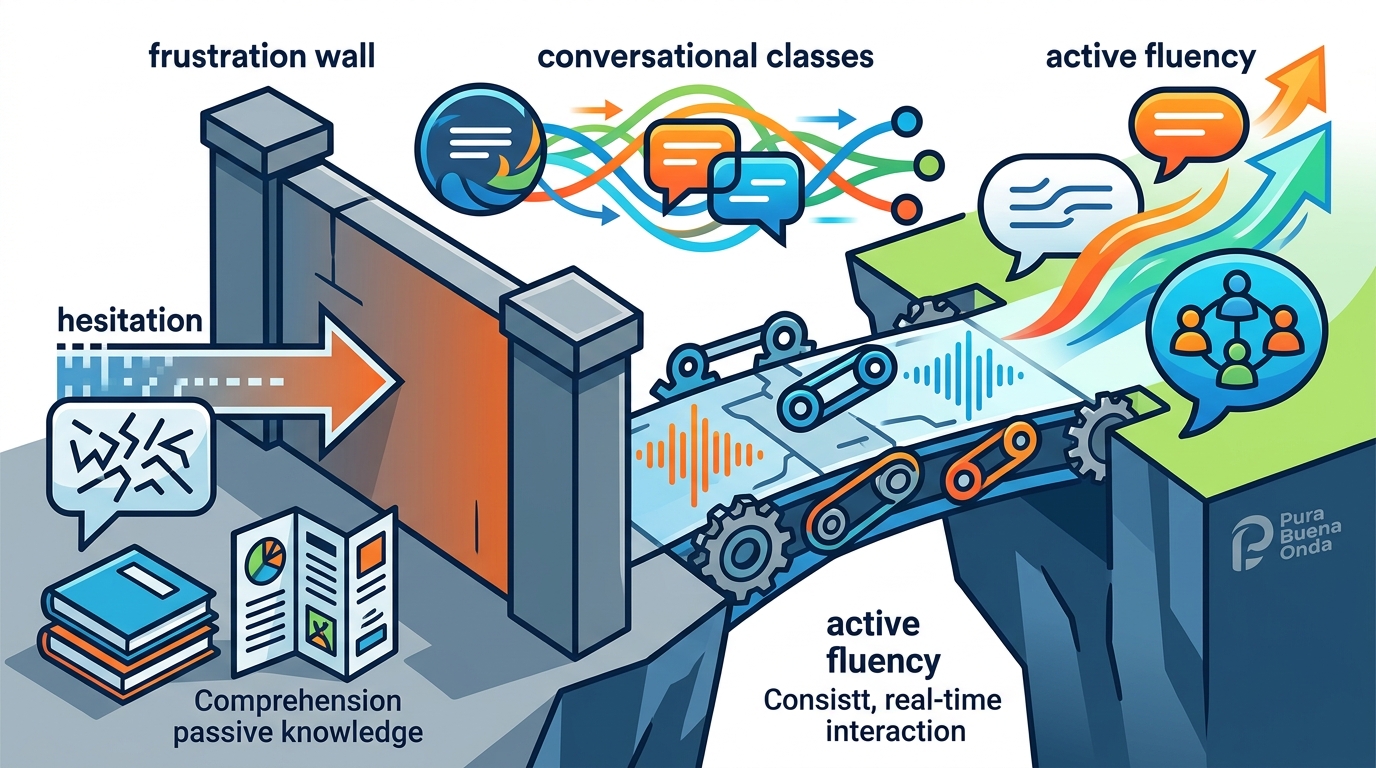
Adults who want to improve their Spanish often hit a frustrating wall. You can read a menu, but you freeze when someone asks you a question. This gap between passive knowledge and active fluency is common. Research indicates that consistent, real-time interaction is the primary driver of speech production skills. Without speaking, the brain treats the language as data to be stored, not a tool to be used. This article outlines the exact steps to bridge that gap.
Why Apps Fail at Teaching Speech
Most adults start their journey with a popular language application. These tools are excellent for vocabulary retention and basic grammar recognition. However, they lack the critical component of spontaneous human interaction. When you type an answer into an app, you have time to translate. When you speak to a person, you do not.
Language acquisition requires production, not just input. You cannot learn to swim by reading a book about hydrodynamics. Similarly, you cannot learn to speak by memorizing conjugation tables. The brain needs to build neural pathways that connect thought directly to speech. This process only happens when you are forced to respond in real time.
According to linguistic studies on second language acquisition, communicative competence is developed through negotiation of meaning. This means you must struggle to be understood and receive feedback. Apps rarely provide the nuanced correction that a human teacher offers. They also do not simulate the pressure of social interaction. This is why many learners feel confident after six months of app use, only to panic when ordering coffee in Madrid.
To fix this, you must shift your focus from memorization to communication. Fluency is a physical skill, not an intellectual one. You need to train your mouth muscles and your auditory processing simultaneously. This requires a environment where mistakes are expected and corrected gently. It requires a space where you can vent, joke, and share personal stories in Spanish.
The Immersion Reality for Non-Travelers
Many people believe they must move to a Spanish-speaking country to achieve fluency. While immersion is powerful, it is not the only path. You can create a high-intensity immersion environment in your daily life. This involves changing how you consume media and how you interact with others.
Daily exposure is more effective than weekly cramming. Listening to Spanish podcasts during your commute helps tune your ear to the rhythm of the language. However, listening alone is passive. You must actively engage with the content. Try repeating phrases out loud. Shadow the speakers. Mimic their intonation.
Another critical step is finding a community. Isolation is the enemy of language learning. When you learn alone, you lack accountability. When you learn with others, you have social pressure to show up. This is why group dynamics are so powerful. You are not just learning words; you are building relationships. These relationships provide the emotional context that makes vocabulary stick.
Consider the concept of buena onda. This phrase refers to a positive connection between people. In a learning context, it means creating a relaxed, non-intimidating environment. When you feel safe, your brain lowers its affective filter. This allows information to flow in more easily. Stress blocks learning. Joy accelerates it.
Choosing the Right Class Format
Not all classes are created equal. The format you choose determines how much you speak. If you join a large lecture hall, you will likely spend 90 percent of the time listening to the teacher. This is passive learning. It is inefficient for speech improvement.
You need small groups. Small groups ensure that every student gets significant speaking time. In a class of three to six people, you might speak for 20 minutes per session. In a class of 20, you might speak for two minutes. The difference is massive. More speaking time equals faster progress.
Here is a comparison of the most effective formats for adult learners:
| Format | Speaking Time | Best For | Cost Efficiency |
|---|---|---|---|
| Small-Group Classes | High (20+ mins) | Building confidence and social skills | Medium |
| Semi-Private Classes | Very High (30+ mins) | Targeted feedback and scheduling | Medium-High |
| Private Classes | Maximum (45+ mins) | Specific goals and rapid progress | Low |
Small-group classes offer a unique balance. You get the support of peers and the attention of a teacher. You also get to hear other people make mistakes. This normalizes the learning process. It reduces the fear of judgment. When you hear someone else struggle with a verb tense, you realize it is a normal part of the journey.
Semi-private classes are ideal for couples or friends. You can practice together and hold each other accountable. Private classes are for those who need maximum flexibility or have very specific professional needs. However, they can be expensive and lack the social dynamic of group interaction.
The Power of Structured Intensity
For adults with busy schedules, consistency is the hardest part of learning. You might take a class once a week. But if you do not practice the other six days, you lose momentum. Language skills are fragile. They fade quickly without reinforcement.
This is where a structured bootcamp becomes valuable. A bootcamp is not just a class. It is a comprehensive system. It combines daily tasks, weekly classes, and monthly events. It forces you to engage with the language every single day. This intensity accelerates learning significantly.
Consider a 90-day challenge. You commit to 30 minutes of daily practice. This might include responding to a daily conversation prompt, watching a short video, or speaking with a partner. You also attend one class per week. This structure ensures that you are always moving forward.
The key is accountability. When you know you have to post a response online or attend a class, you are more likely to do it. You cannot skip. You cannot procrastinate. This external pressure helps build the internal habit. Over time, the habit becomes automatic. You start thinking in Spanish without trying.
Additionally, bootcamps often include social events. These events allow you to practice in a low-stakes environment. You might go to a dinner or a cultural outing. This helps you apply what you learned in class to real-world situations. It bridges the gap between the classroom and the street.
Key Takeaways
- Production over Input: You must speak to learn to speak. Passive listening is insufficient for fluency.
- Small Groups Matter: Classes with 3 to 6 students maximize your speaking time and reduce anxiety.
- Daily Consistency: 30 minutes of daily practice is more effective than one long weekly session.
- Structured Intensity: Programs like the 90-Day Spanish Bootcamp provide the accountability needed for rapid progress.
- Community Support: Learning with others creates a positive environment that reduces fear of mistakes.
- Real Conversations: Focus on topics you care about, such as travel, family, or work, to make learning relevant.
- Professional Guidance: Experienced teachers provide real-time corrections that apps cannot offer.
Frequently Asked Questions
How long does it take for an adult to become fluent in Spanish?
Fluency timelines vary based on intensity and prior language knowledge. However, consistent daily practice with a focus on speaking can yield noticeable results in 3 to 6 months. Immersion accelerates this process significantly.
Can I learn to speak Spanish online effectively?
Yes. Online classes via Zoom allow for real-time interaction with teachers and peers. The key is to choose small groups where you are forced to speak. Passive online courses are less effective for speech improvement.
What is the difference between a small-group class and a bootcamp?
A small-group class is a weekly session focused on conversation. A bootcamp is a 90-day program that includes weekly classes plus daily tasks and accountability measures. The bootcamp is more intense and structured.
Do I need to live in San Diego to join these classes?
No. While some social events are in San Diego, the core classes are online. This allows students from anywhere to join the community and practice speaking Spanish.
What if I am a complete beginner?
Beginners are welcome. Classes are divided by level. You will start with basic phrases and gradually build up to complex conversations. The environment is designed to be non-judgmental and supportive.
How much time should I dedicate to daily practice?
A minimum of 20 to 30 minutes per day is recommended. This can include listening to podcasts, responding to daily prompts, or reviewing vocabulary. Consistency is more important than duration.
Is it better to learn alone or with a partner?
Learning with a partner or in a group provides accountability and social motivation. It also simulates real conversation better than studying alone. However, private lessons offer the most personalized feedback.
Start Speaking Today
Stop waiting for the perfect moment. The perfect moment is now. You have the tools. You have the knowledge. Now you need the practice. Join a community that prioritizes real conversation over rote memorization. Take the first step toward fluency by exploring our class options or booking a free consultation. Your future self will thank you for starting today.