

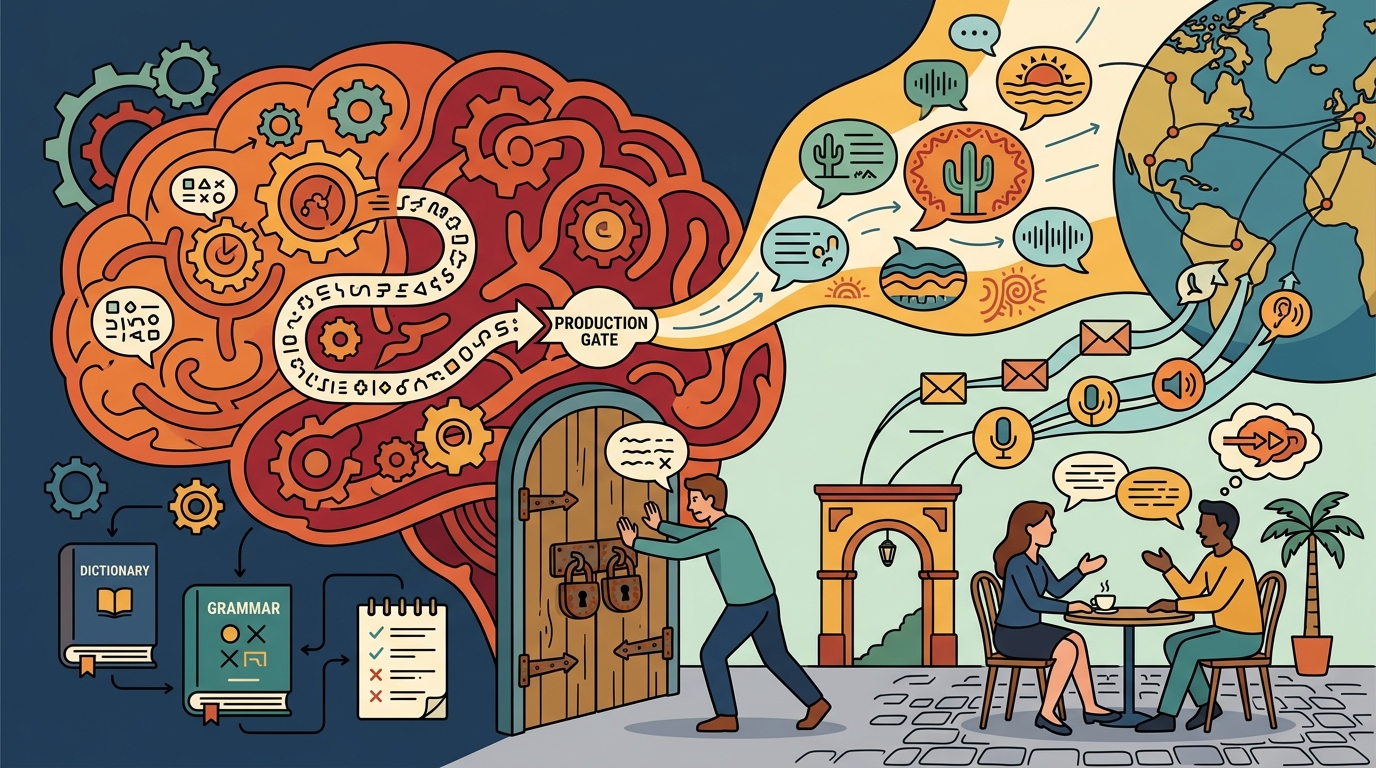
Most adults hit a wall in their language journey. They memorize vocabulary lists, complete grammar exercises, and still freeze when a native speaker asks a simple question. This phenomenon is not a lack of intelligence. It is a lack of production. According to recent language acquisition research, passive consumption of content accounts for less than 20% of actual speaking fluency development. The remaining 80% requires active, high-stakes verbal output in low-pressure environments. If you are tired of understanding Spanish but failing to speak it, you must change your methodology immediately.
Why Passive Learning Fails Adults
Adults approach language learning like a university exam. We study the rules. We memorize the conjugations. We wait until we feel "ready" to speak. This approach is fundamentally flawed. Language is a motor skill, not an academic subject. You cannot learn to play tennis by reading a book about tennis. You cannot learn to swim by watching videos of swimmers. You must enter the water. You must pick up the racket.
The primary barrier for adults is the fear of judgment. In a traditional classroom, the anxiety of making mistakes in front of peers often paralyzes speech. This creates a feedback loop where the student understands more than they can produce. This gap widens over time, leading to frustration and eventual abandonment of the language. To break this cycle, you need an environment that prioritizes communication over perfection.
Research indicates that stress inhibits the brain's ability to retrieve linguistic data. When you are anxious, your cognitive load increases, leaving less processing power for language formulation. Therefore, the first step to getting better at speaking Spanish is to lower your affective filter. You need a space where mistakes are not just tolerated, but expected and celebrated as part of the learning process.
The Conversation Immersion Method
Immersion does not require moving to a Spanish-speaking country. It requires creating a micro-immersion environment where your brain is forced to process Spanish in real-time. The most effective way to do this is through structured conversation classes. Unlike traditional courses that focus on textbook drills, conversation classes simulate real-world interactions.
In these sessions, you discuss current events, personal experiences, and hypothetical scenarios. This forces your brain to access vocabulary dynamically rather than statically. Dynamic vocabulary access builds neural pathways that static memorization cannot replicate. When you discuss your weekend plans in Spanish, you are linking the language to your personal identity and daily life, which significantly improves retention.
Furthermore, conversation classes provide immediate feedback. Native speakers or advanced instructors can correct your pronunciation and grammar in context. This real-time correction is crucial for adults who have already formed incorrect habits. Without immediate feedback, you risk fossilizing errors that become harder to unlearn over time. The goal is to acquire the language naturally, similar to how children learn, by focusing on meaning before form.
Choosing the Right Class Structure
Not all language classes are created equal. The structure of your learning environment dictates the amount of speaking time you get. Large classes often result in minimal individual speaking time. Small groups or private sessions maximize your opportunity to practice. Below is a comparison of common class structures to help you decide which fits your goals.
| Class Type | Speaking Time | Best For | Cost Efficiency |
|---|---|---|---|
| Small-Group Classes | High (3-6 students) | Building confidence and community | Medium |
| Semi-Private Classes | Very High (2 students) | Targeted feedback and scheduling | Medium-High |
| Private Classes | Maximum (1 student) | Rapid progress and specific goals | Low |
| Traditional Group | Low (10+ students) | Basic grammar introduction | High |
Small-group classes offer a unique balance of social interaction and individual attention. With three to six students, everyone gets ample time to speak without the pressure of being the sole focus. This setting mimics a social gathering, reducing anxiety and encouraging natural flow. Many students find that the camaraderie in small groups motivates them to attend consistently, which is critical for progress.
Semi-private classes are ideal for couples or friends who want to learn together. The dynamic between two students allows for deeper conversation and more personalized correction. Private classes offer the fastest route to fluency because the curriculum is tailored entirely to your needs. However, they lack the social component that makes language learning enjoyable and sustainable.
Daily Accountability Habits
Consistency beats intensity in language learning. Studying for five hours once a week is less effective than studying for thirty minutes every day. To get better at speaking Spanish, you must integrate it into your daily routine. This requires building habits that force you to use the language outside of formal class hours.
One effective method is the "Daily Conversation" challenge. Commit to responding to a Spanish prompt every day. This could be a question about your day, a description of a photo, or a summary of a news article. The key is to do it daily, not weekly. This habit trains your brain to switch into Spanish mode regularly, reducing the cognitive load required to start speaking.
Another powerful habit is engaging with native content. Watch a YouTube video or listen to a podcast in Spanish daily. Do not rely on subtitles in your native language. Force your brain to process the audio. If you do not understand a word, guess from context. This skill of inference is crucial for real-world communication. Over time, your brain will become adept at filling in the gaps, improving your listening comprehension and speaking confidence simultaneously.
Finally, join a community. Whether it is an online forum, a local meetup, or a social media group, being part of a community provides accountability. When you know others are expecting your daily contribution, you are less likely to skip it. This social pressure is a positive force that drives consistent practice.
Overcoming the Intermediate Plateau
Many adults reach an intermediate level and then stall. They can hold basic conversations but struggle with complex topics. This is known as the intermediate plateau. It occurs because the easy vocabulary and grammar rules have been mastered, and the remaining progress requires more effort and nuanced understanding.
To break through the plateau, you must challenge yourself with more complex content. Discuss abstract concepts, debate opinions, and tell stories with intricate details. This forces you to use advanced vocabulary and complex sentence structures. It is uncomfortable, but that discomfort is a sign of growth.
Additionally, focus on pronunciation and intonation. At the intermediate level, being understood is not enough. You want to sound natural. Mimic native speakers. Record yourself speaking and compare it to native audio. Pay attention to rhythm and stress patterns. These subtle elements distinguish a learner from a fluent speaker.
Consider joining a specialized program like a 90-day bootcamp. These intensive programs combine daily practice, weekly accountability, and community support to accelerate progress. They are designed to push you out of your comfort zone and build new habits that stick. The structure provides the discipline that self-study often lacks.
Key Takeaways
- Active Production is Key: Speaking fluency requires active verbal output, not just passive listening or reading.
- Lower the Affective Filter: Choose a learning environment that is non-judgmental and fun to reduce anxiety.
- Small Groups Work Best: Small-group classes offer the optimal balance of speaking time and social support.
- Daily Consistency: Thirty minutes of daily practice is more effective than five hours of weekly study.
- Community Matters: Joining a community or bootcamp provides accountability and motivation.
- Embrace Mistakes: View errors as data points for improvement, not failures.
- Real-World Context: Discuss personal experiences and current events to make the language relevant.
Frequently Asked Questions
How long does it take for an adult to become fluent in Spanish?
Fluency timelines vary based on intensity and method. With daily practice and conversation immersion, many adults see significant improvement in six to twelve months. However, true fluency is a lifelong journey of refinement.
Is it better to learn Spanish online or in person?
Both methods have merits. Online classes offer flexibility and access to native speakers globally. In-person classes provide face-to-face interaction and local community building. The best method is the one you will attend consistently.
Can I learn Spanish without traveling to a Spanish-speaking country?
Yes. Immersion can be created through conversation classes, media consumption, and daily practice. Many fluent speakers learned entirely through structured online programs and local meetups.
What is the best age to start learning Spanish?
It is never too late. Adults have advantages such as discipline, analytical skills, and life experience. While children may acquire accent more easily, adults can achieve high levels of fluency through dedicated effort.
How do I overcome the fear of speaking Spanish?
Start in a low-pressure environment. Join a small group or take private lessons with a supportive instructor. Focus on communication, not perfection. Celebrate small victories and be patient with yourself.
Do I need to know grammar rules to speak Spanish?
Understanding grammar helps, but it is not a prerequisite for speaking. Many fluent speakers acquired grammar intuitively through exposure and practice. Focus on communication first, and refine grammar later.
What is the Pura Buena Onda method?
Pura Buena Onda focuses on conversational immersion in a relaxed, non-intimidating environment. The method prioritizes real-life conversations and community building over traditional grammar drills.
Start Speaking Today
Stop waiting for the perfect moment. The perfect moment is now. You have the tools. You have the knowledge. What you need is the opportunity to practice in a supportive environment. Pura Buena Onda offers small-group, semi-private, and private Spanish classes designed to get you speaking from day one. Our classes are held online via Zoom, making them accessible to everyone. Join our community and experience the joy of real conversation. Contact us today to schedule your first class and take the first step toward fluency.