

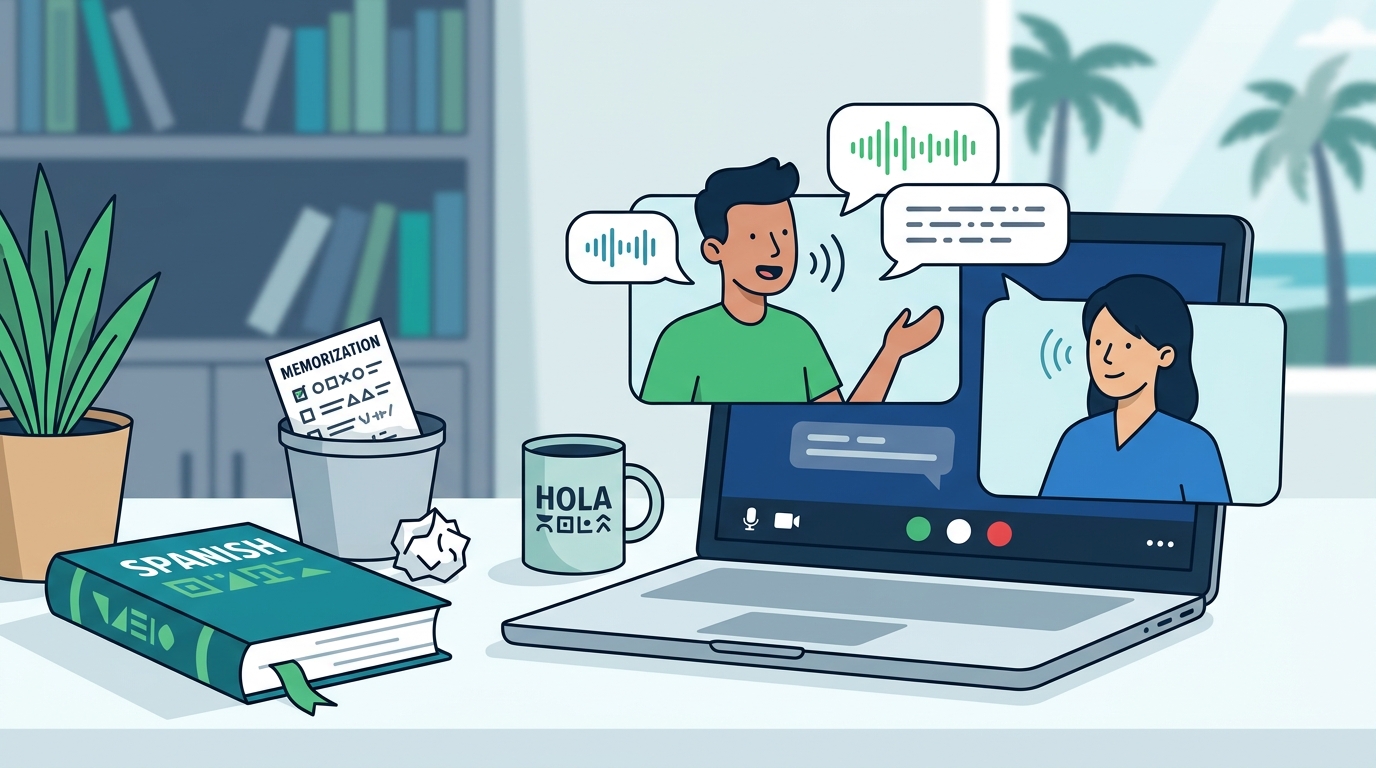
Starting a new language journey is often romanticized as a quiet, solitary study session with a textbook. The reality is far more dynamic and significantly more effective when approached through interaction. According to recent language acquisition data, learners who engage in active conversation within their first month of study are significantly more likely to retain vocabulary and achieve fluency compared to those relying solely on passive memorization. This shift from passive consumption to active production is the cornerstone of modern language pedagogy.
If you are standing at the threshold of learning Spanish, you might feel overwhelmed by the sheer volume of apps, grammar rules, and conflicting advice available online. The good news is that you do not need to master the subjunctive mood before you can order a coffee or make a friend. This guide outlines the most effective, low-friction path to becoming a confident Spanish speaker, leveraging the principles of immersive learning.
Why Traditional Apps Fail Beginners
Most beginners start with a popular language application. These tools are excellent for initial vocabulary exposure, but they suffer from a critical flaw: they simulate conversation without providing the feedback loop necessary for correction. When you type "el gato come manzana," the app accepts it. A human teacher notices that you missed the article "la" and the plural context.
This is where the concept of comprehensible input becomes vital. Comprehensible input is material that is slightly above your current level of understanding, allowing you to grasp meaning through context. Apps often provide input that is either too rigid or too abstract. Real-world Spanish, however, is messy, fast, and filled with idioms that no algorithm can fully predict.
Consider the phrase "my in-laws are driving me crazy." An app might teach you the literal translation of each word. A conversational class teaches you how to express frustration naturally, using the correct tone and body language. This nuance is what separates a tourist from a speaker.
The Immersion Method Explained
Immersion does not require a plane ticket to Madrid or Mexico City. It requires a shift in your daily environment. The most effective way to immerse yourself is through social language practice. This involves engaging with native speakers or other learners in a structured, low-pressure environment.
At Pura Buena Onda, we utilize a methodology that prioritizes speaking from day one. This approach is based on the linguistic principle that language is a skill, much like playing tennis or swimming. You cannot learn to swim by reading a book about hydrodynamics. You must get in the water. Similarly, you cannot learn to speak Spanish by memorizing grammar charts. You must speak.
This method relies on three pillars:
- Real-time Correction: Immediate feedback prevents the fossilization of errors.
- Contextual Learning: Vocabulary is learned through stories and scenarios, not isolated lists.
- Emotional Connection: Laughter and shared experiences create stronger memory pathways than rote repetition.
Choosing Your Learning Path
Once you accept that speaking is the goal, you must choose the format that fits your lifestyle. There is no single "best" way, but there are distinct advantages to each model.
| Format | Best For | Key Benefit | Commitment Level |
|---|---|---|---|
| Small-Group Classes | Social learners | High interaction, peer support | Weekly attendance |
| Semi-Private Classes | Couples or friends | Personalized pacing, shared cost | Weekly attendance |
| Private Classes | Busy professionals | 100% tailored content | Flexible scheduling |
| 90-Day Bootcamp | Rapid progress seekers | Intensive daily practice | Daily tasks + weekly classes |
For absolute beginners, small-group classes are often the most forgiving environment. You are surrounded by others who are also figuring things out, which reduces the anxiety of being the "only one" who doesn't know the answer. The 2026 Group Class Schedule is designed to accommodate various time zones, ensuring that online learners from San Diego to Seattle can participate.
Building Daily Habits
Consistency beats intensity. Studying for five hours once a week is far less effective than studying for twenty minutes every day. Language acquisition is a cumulative process. Your brain needs frequent exposure to build neural pathways for new sounds and structures.
To build this habit, integrate Spanish into your existing routine. Listen to a Spanish podcast during your commute. Change your phone language to Spanish. Follow Spanish-speaking accounts on Instagram for daily vocabulary prompts. These micro-interactions keep the language active in your mind without feeling like "study time." For those who need more structure, the Pura Buena Onda Patreon offers a curated library of grammar courses and native speaker interviews. This resource allows you to dive deeper into specific topics, such as the difference between "ser" and "estar," at your own pace. The cost is minimal, but the value of hearing how a native speaker actually uses these verbs in real life is immeasurable.
Overcoming the Fear of Speaking
The biggest barrier to learning Spanish is not grammar. It is the fear of making mistakes. Many beginners stay silent because they worry about their accent or conjugation errors. This is a natural reaction, but it is counterproductive.
Native speakers are generally incredibly patient and encouraging. They appreciate the effort. In a supportive classroom environment, mistakes are celebrated as evidence of learning. When you make a mistake and are corrected, your brain registers the correction more strongly than if you had gotten it right by chance.
Embrace the awkwardness. The first few months will feel clumsy. You will forget words. You will mix up genders. This is not failure. This is the process. As you continue, the words will start to come faster. The grammar will start to feel intuitive. The confidence will follow.
Key Takeaways
- Active Practice is Essential: Language is a skill acquired through doing, not just reading. Prioritize speaking from day one.
- Consistency Matters: Daily exposure, even for short periods, builds stronger neural pathways than sporadic long sessions.
- Community Supports Success: Learning with others reduces anxiety and provides accountability. Joining a small-group class is a proven way to stay motivated.
- Immersion is Accessible: You do not need to travel to immerse yourself. Online classes and social events provide real-world practice.
- Feedback is Critical: Real-time correction from native speakers prevents bad habits from forming.
- Flexibility is Key: Choose a format that fits your schedule, whether it is private lessons or a 90-day bootcamp.
- Start Now: The best time to begin is today. Every conversation you have brings you closer to fluency.
Frequently Asked Questions
Do I need any prior knowledge of Spanish to start?
No. Our beginner classes are designed for absolute novices. We start with the basics, such as greetings and essential phrases, and build from there. The environment is non-judgmental, so you can start from zero.
How often should I attend classes to see results?
For steady progress, we recommend attending at least one class per week. However, for faster results, especially if you are using the Bootcamp method, daily practice combined with weekly classes is ideal. Consistency is the most important factor.
Can I take classes if I live outside of San Diego?
Absolutely. Our online classes are conducted via Zoom, making them accessible to anyone with an internet connection. We have students from all over the world joining our virtual community.
What is the difference between a small-group class and a semi-private class?
A small-group class typically includes 4-6 students, offering a balance of individual attention and peer interaction. A semi-private class is for two students, often friends or couples, allowing for even more personalized pacing and conversation time.
How long does it take to become conversational?
This varies by individual, but with consistent practice, most students feel noticeably more confident within three to six months. The 90-Day Bootcamp is specifically designed to accelerate this process through intensive daily engagement.
Do I need to buy textbooks?
No. Our methodology relies on real-world materials and conversation. We may recommend supplementary resources like our Patreon for additional practice, but traditional textbooks are not required.
What if I miss a class?
We understand that life happens. Our classes are flexible, and you can often make up a missed session by attending another class at a different time. For the Bootcamp, there are specific make-up protocols to ensure you stay on track.
Start Your Spanish Journey Today
Learning Spanish is one of the most rewarding investments you can make in yourself. It opens doors to new cultures, friendships, and opportunities. But it requires a step into the unknown. Do not let fear or perfectionism hold you back.
Join a community that values real conversation over rote memorization. Whether you choose a small-group class, a private lesson, or the intensive 90-Day Bootcamp, you will be guided by experienced teachers who are dedicated to your success.
Ready to break through your plateau? Contact us today to schedule a free consultation or browse our 2026 Class Schedule. Your future fluent self is waiting.