

Most language learners hit a wall within their first six months. According to recent industry data, nearly 70% of beginners abandon their studies because they rely on passive memorization rather than active production. This statistic highlights a critical failure in modern language acquisition strategies. You cannot learn to speak Spanish by reading about it. You must engage in real-time communication to build the neural pathways required for fluency. This guide outlines the most frequent pitfalls and provides concrete methods to bypass them.
The App Trap and Passive Learning
Many beginners start with mobile applications that prioritize vocabulary matching over conversational ability. These tools teach you how to say "the dog eats an apple" but fail to prepare you for real-world interactions. Research from language education experts confirms that passive input without active output creates a false sense of competence. You might recognize words, but you cannot produce them under pressure.
To avoid this trap, you must shift from memorization to production. Fluency happens when you stop memorizing and start speaking. Engage in live conversations where you are forced to formulate thoughts in real time. This approach mirrors how children acquire their first language through immersion rather than textbook drills.
Fear of Making Grammatical Errors
Perfectionism is the enemy of language acquisition. Beginners often hesitate to speak because they fear conjugating a verb incorrectly or using the wrong gender for a noun. This anxiety creates a mental block that prevents progress. Studies in cognitive psychology show that anxiety inhibits the brain's ability to retrieve linguistic information during communication.
The solution is to embrace mistakes as essential data points. Every error provides immediate feedback that helps your brain adjust its internal model of the language. Join a supportive environment where errors are corrected gently and immediately. This method accelerates learning by turning mistakes into teaching moments rather than sources of shame.
Ignoring Pronunciation and Listening
Many learners focus exclusively on reading and writing, neglecting the auditory component of language. This imbalance leads to an inability to understand native speakers who speak at natural speeds. According to recent neurological studies, the brain requires distinct processing time for auditory input versus visual text. Ignoring listening practice leaves a critical gap in your communicative ability.
You must train your ear to recognize the rhythm and intonation of Spanish. Listen to native content daily, even if you only understand fragments. Over time, your brain will begin to segment the stream of speech into recognizable words. This auditory training is just as important as vocabulary building.
Studying in Isolation
Language learning is inherently social. Attempting to master Spanish alone removes the accountability and motivation that come from community interaction. Data from educational institutions indicates that learners in group settings retain information longer due to peer reinforcement and shared experiences.
Join a class or a language exchange group. The social pressure to show up and participate keeps you consistent. Additionally, interacting with others exposes you to diverse accents and speaking styles, which is crucial for real-world comprehension. Real-life Spanish needs real-life conversations.
Lack of Consistent Daily Practice
Inconsistency is the primary reason for stalled progress. Many beginners study intensely for a few days and then disappear for weeks. This sporadic approach prevents the formation of long-term memory habits. According to memory retention research, spaced repetition and daily exposure are far more effective than cramming.
Commit to a daily routine, even if it is only 15 minutes long. Consistency builds momentum. Use tools like daily conversation prompts or short listening exercises to maintain engagement. The goal is to make Spanish a natural part of your daily life, not a separate chore.
Comparing Learning Methods for Beginners
Choosing the right method can accelerate your progress significantly. The table below compares common approaches based on effectiveness for conversational fluency.
| Method | Focus | Effectiveness for Speaking | Best For |
|---|---|---|---|
| Online Live Classes | Real-time conversation | High | Active learners seeking immediate feedback |
| Mobile Apps | Vocabulary matching | Low | Initial exposure and casual practice |
| Textbooks | Grammar rules | Medium | Structured learners who prefer self-study |
| Intensive Bootcamps | Daily immersion | Very High | Rapid progress and habit formation |
Key Takeaways
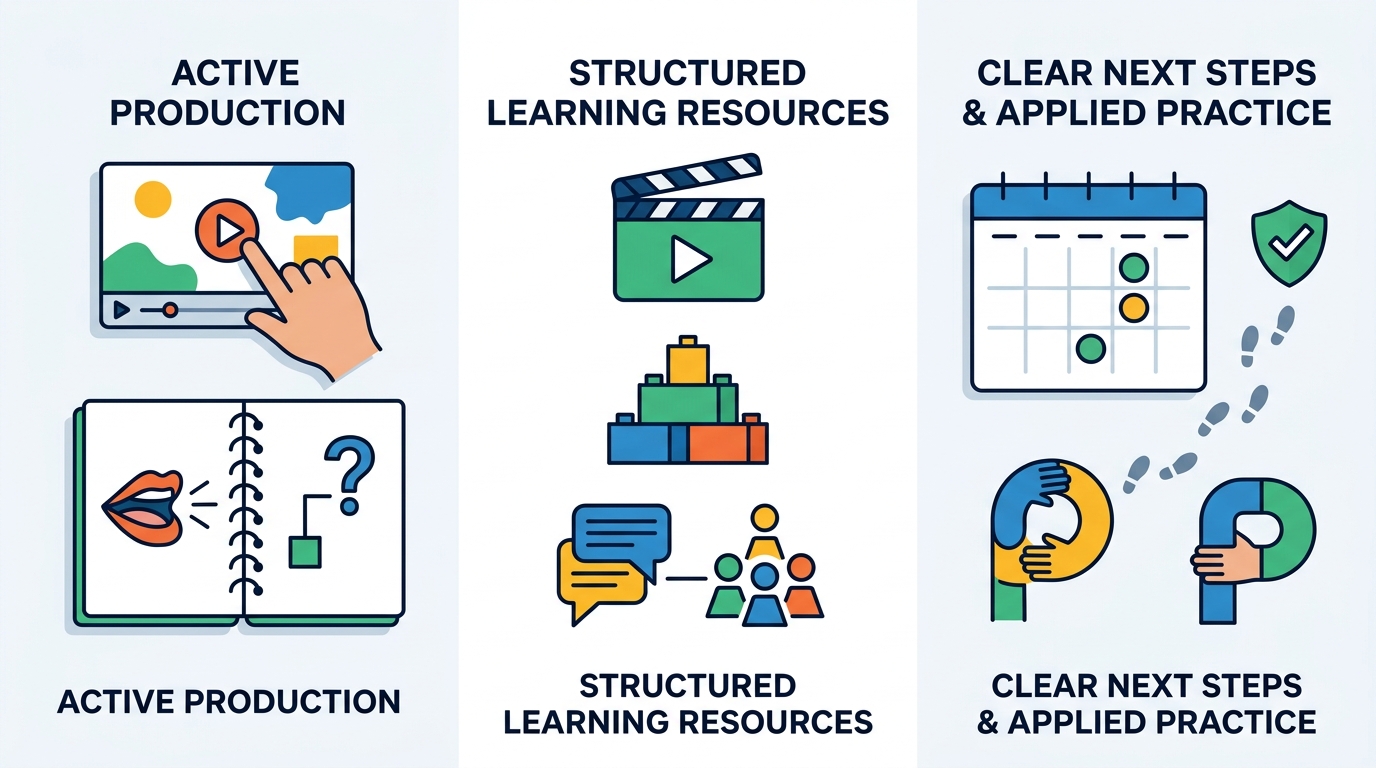
- Active Production: Fluency requires speaking, not just recognizing words.
- Embrace Errors: Mistakes are necessary data points for learning.
- Auditory Training: Listening to native speech is critical for comprehension.
- Community Support: Group learning provides accountability and diverse exposure.
- Daily Consistency: Short, daily practice beats sporadic intense sessions.
- Real-World Context: Learn phrases used in actual conversations, not just textbook examples.
- Professional Guidance: Native speakers provide corrections that apps cannot.
Frequently Asked Questions
How long does it take to become conversational in Spanish?
With daily practice and live conversation, most beginners can hold basic conversations within three to six months. Consistency is the primary driver of this timeline.
Is it better to learn Spanish online or in person?
Online classes offer flexibility and access to native speakers from various regions. Our online classes provide the same conversational benefits as in-person sessions with greater scheduling freedom.
What is the best way to practice pronunciation?
Practice with native speakers who can correct you in real time. Listening to native content and mimicking their intonation is also highly effective.
Can I learn Spanish without traveling to a Spanish-speaking country?
Yes. Immersion can be created through daily practice, media consumption, and live conversation classes. Pura Buena Onda facilitates this immersion remotely.
How do I stay motivated to learn Spanish?
Join a community or a bootcamp to maintain accountability. Setting specific, achievable goals and tracking your progress also helps sustain motivation.
What is the difference between ser and estar?
Ser is used for permanent characteristics, identity, and time. Estar is used for temporary states, locations, and emotions. Understanding this distinction is crucial for accurate communication.
Do I need to know grammar rules before speaking?
No. You can begin speaking immediately. Grammar rules will become clearer as you encounter them in context. Focusing on communication first builds confidence.
Start Your Spanish Journey Today
Stop letting common mistakes hold you back. Join a community that prioritizes real conversation and genuine progress. Schedule a free consultation to discuss your goals and find the perfect learning path for you. Take the first step toward fluency today.