

Common Mistakes in Adult Spanish Conversation Classes and How to Correct Them
Adult learners often abandon their Spanish studies not because they lack intelligence, but because they fall into predictable conversational traps. According to recent language acquisition data, over 60% of adult learners plateau because they prioritize grammatical perfection over communicative flow. This approach creates a mental block that prevents fluency. At Pura Buena Onda, we have spent 19 years observing these patterns in our San Diego and online classrooms. We know exactly where students stumble and how to help them recover. This guide outlines the most frequent errors and provides the specific corrective actions needed to break through your current level.
The Translation Trap: Why Mental Translation Kills Fluency
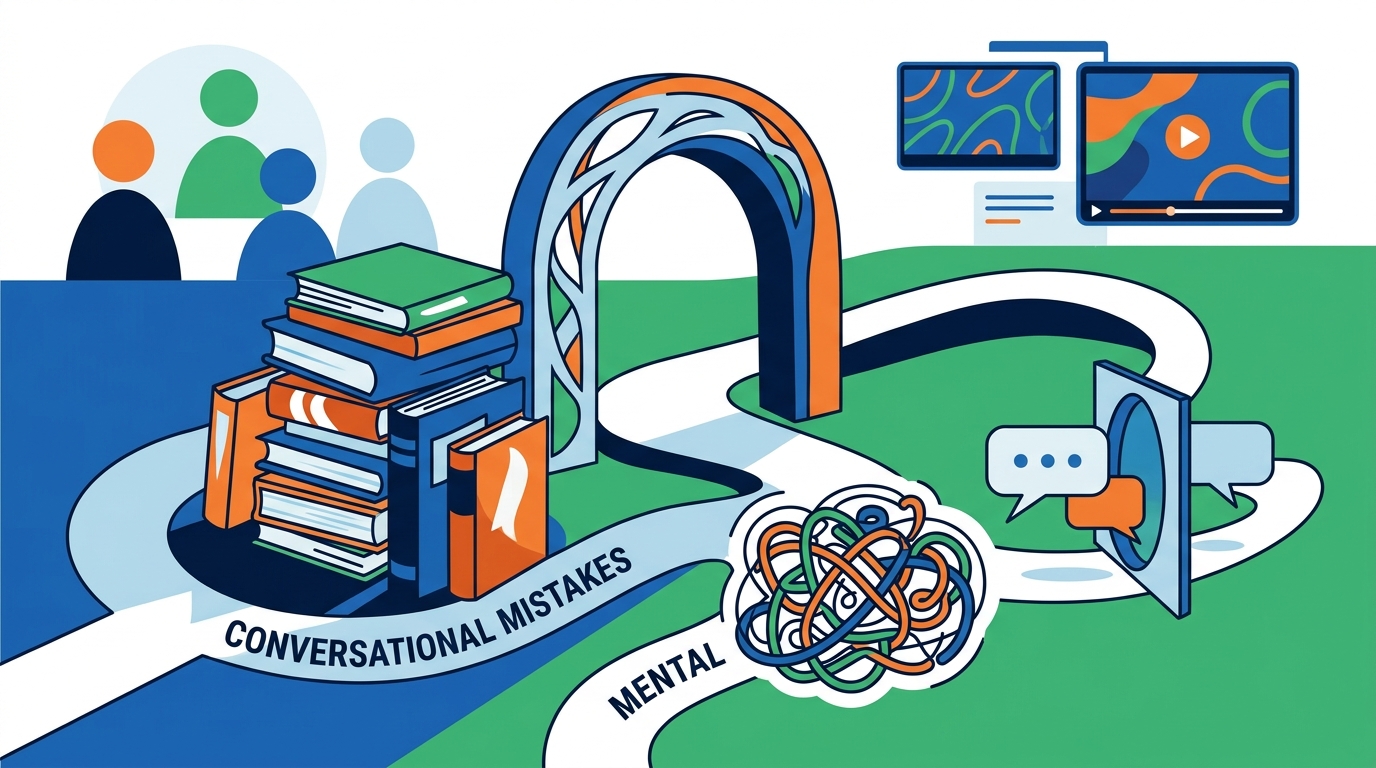
The most common mistake adult learners make is translating word-for-word from English to Spanish in their heads. This process is slow and often results in awkward, unnatural phrasing. Native speakers do not translate; they think in their target language. When you pause to construct a sentence grammatically, you lose the rhythm of the conversation. This delay breaks the flow and makes it difficult for your partner to respond naturally.
To correct this, you must embrace the concept of comprehensible input. This is a linguistic theory suggesting that learners acquire language best when they understand messages that are slightly above their current level. Instead of translating, focus on the core meaning of what is being said. If you do not know a word, guess from context. This builds neural pathways for direct association rather than indirect translation.
Our Small-Group Spanish Classes are designed to force this shift. The pace is fast enough that you cannot rely on translation, but supportive enough that you never feel lost. You will learn to think in Spanish by necessity, not by choice.
Fear of Judgment: The Silent Fluency Killer
Adults are conditioned to be perfect. In professional settings, errors have consequences. In language learning, however, errors are the primary mechanism of growth. Many students hesitate to speak because they fear sounding foolish. This fear leads to silence, and silence is the enemy of progress. You cannot learn to swim by watching others swim. You must get in the water.
The correction is simple: adopt a growth mindset. View every mistake as data. When a teacher corrects you, it is not a criticism; it is a gift. It highlights a specific gap in your knowledge that you can now fill. At Pura Buena Onda, we cultivate a zero-judgment environment. Our students laugh at their mistakes together. This shared vulnerability creates a safe space where learning accelerates.
If you are struggling with this fear, consider our Semi-Private Spanish Classes. The smaller group size reduces the anxiety of performing in front of a large audience while still providing the social interaction necessary for conversational practice.
Ignoring Contextual Nuance and Regional Variations
Spanish is not a monolith. It varies significantly by region. A word that means "computer" in one country might mean "candy" in another. Many learners make the mistake of memorizing vocabulary lists without understanding the cultural context. This leads to confusion when they encounter native speakers from different backgrounds. For example, the word "coche" means car in Spain, but in many Latin American countries, it might refer to a baby carriage.
To correct this, you must expose yourself to diverse Spanish. Listen to native speakers from different countries. Our native speaking teachers come from across Latin America and Spain. They bring their unique dialects and cultural references into the classroom. This exposure is crucial for developing a flexible ear. You learn to understand that there is no single "correct" way to speak Spanish, only different ways to communicate effectively.
We also offer a Patreon membership that includes interviews with native teachers. These sessions allow you to hear how Spanish actually sounds across different countries. You will learn vocabulary that makes you sound more native, not more textbook. This is essential for anyone who wants to travel or work in diverse Spanish-speaking environments.
Passive Listening vs. Active Engagement
Many students attend classes but remain passive. They listen to the teacher but do not participate actively. This is a critical error. Language is a skill, like playing a sport. You cannot learn it by watching. You must do it. Passive listening provides some benefit, but active speaking provides exponential benefits.
The correction is to commit to active participation. Ask questions. Challenge your classmates. Tell stories. Even if you make mistakes, the act of producing language strengthens your neural pathways. Our Online Classes are structured to ensure everyone speaks. The teacher facilitates, but the students drive the conversation. This ensures that you are not just a spectator in your own learning journey.
Inconsistent Practice Habits
Language learning is a marathon, not a sprint. Many students attend classes regularly for a few months and then stop. When they return, they have forgotten much of what they learned. This inconsistency is a major barrier to fluency. The brain forgets what it does not use. To retain vocabulary and grammar, you need daily exposure.
To correct this, build a daily habit. This does not mean studying for hours. It means engaging with the language for 15-20 minutes every day. This could be reading a news article, listening to a podcast, or having a short conversation. Our 90-Day Spanish Bootcamp is designed to help you build this habit. It combines daily tasks, weekly accountability, and a supportive community to give your Spanish a serious boost. By the end of 90 days, most students advance a level or feel noticeably more confident and fluent.
The Power of Daily Tasks
The Bootcamp requires you to respond to a daily conversation question on Facebook. This forces you to produce language every day. It also requires you to engage with Instagram posts and watch YouTube videos. These small, daily actions compound over time. They create a routine that sticks. This is the best way to give your Spanish a boost, short of moving to a Spanish-speaking country for 90+ days.
Key Takeaways
- Stop Translating: Focus on comprehensible input and direct association to build fluency.
- Embrace Mistakes: View errors as data, not failures. A zero-judgment environment accelerates learning.
- Seek Diversity: Expose yourself to different dialects and regional variations to understand contextual nuance.
- Be Active: Passive listening is insufficient. You must speak and participate to improve.
- Stay Consistent: Daily practice is more effective than occasional intense study. Build a habit.
- Use Community: Join a supportive group like Pura Buena Onda to stay accountable and motivated.
- Track Progress: Use tools like the 90-Day Bootcamp to measure your improvement and stay on track.
Frequently Asked Questions
How long does it take to see results in conversation classes?
Results vary by individual, but most students notice improved confidence within the first few weeks. Significant fluency gains typically occur after 3-6 months of consistent practice. Our 90-Day Spanish Bootcamp is specifically designed to accelerate this process through daily engagement.
Do I need to be in San Diego to join?
No. Pura Buena Onda offers Online Classes via Zoom. This allows students from anywhere in the world to participate in live conversations with native speakers. We also host in-person social events in San Diego for local students.
What is the difference between small-group and semi-private classes?
Small-group classes typically have 4-6 students, while semi-private classes have 2-3 students. Semi-private classes offer more personalized attention and speaking time per student. Both formats are effective for building conversational skills.
How does the Patreon membership work?
Our Patreon costs $19/month. It provides access to grammar courses, native teacher interviews, vocabulary lessons, and music lyric explanations. It is designed for students who want to go deeper between classes.
Can I cancel my membership at any time?
Yes. We offer month-to-month flexibility with no contracts. You can join or leave at any time without guilt trips. This allows you to take control of your learning journey.
What levels are available?
We offer 8 levels, from absolute beginner to advanced. This ensures you are never stuck in a class with students who are way more advanced or way behind your skill level. You can find the 2026 Group Class Schedule on our website.
How do I book a free consultation?
You can schedule a free phone consult by visiting our Contact Us page. Our team will help you determine the best class format for your needs.
Ready to Break Your Plateau?
Stop letting fear and bad habits hold you back. Join a community that prioritizes real conversations and real progress. Whether you choose our Small-Group Spanish Classes, Semi-Private Spanish Classes, or the 90-Day Spanish Bootcamp, you will find the support you need to succeed. Click here to book your free consultation today and start speaking Spanish with confidence.