

Common Speaking Mistakes That Fuel Language Anxiety and How to Avoid Them
Language anxiety is not a personal failure; it is a predictable response to perceived linguistic gaps. According to recent educational psychology studies, over 60% of adult language learners report significant stress when attempting spontaneous conversation. This anxiety often stems from a fear of judgment, which creates a mental block that prevents fluency. At Pura Buena Onda, we have observed that this stress is rarely caused by a lack of vocabulary. Instead, it is fueled by specific behavioral mistakes that learners make during practice. By identifying these patterns, you can dismantle the fear response and replace it with confidence.
The Trap of Mental Translation
One of the most common mistakes learners make is attempting to translate their thoughts word-for-word from their native language into Spanish. This process is cognitively expensive and slow. It creates a lag between your thought and your speech, which feels awkward to both you and your listener. This delay often triggers anxiety because you feel like you are falling behind in real-time.
Translation relies on a rigid grammatical structure that rarely matches between languages. For example, the concept of ser vs estar is often explained like a human in our resources, but it requires intuitive understanding rather than logical translation. When you try to translate "I am happy" directly, you might struggle with the verb choice. This struggle is not a sign of low intelligence. It is a sign that you are using the wrong learning tool.
To avoid this, you must practice thinking in chunks. Start with simple phrases. Instead of translating individual words, memorize common expressions as single units of meaning. This reduces the cognitive load and allows your brain to focus on the flow of conversation rather than the mechanics of grammar. Our Patreon community offers specific exercises designed to build this intuitive connection.
The Perfectionism Paradox
Perfectionism is the enemy of fluency. Many learners wait until they are "ready" to speak. They believe they must master all grammar rules before attempting a conversation. This is a fundamental misunderstanding of how language acquisition works. Fluency is the result of practice, not the prerequisite for it.
When you aim for perfection, you become hyper-aware of every mistake. This self-monitoring increases anxiety and makes you hesitant to speak. In a real conversation, native speakers do not expect perfect grammar. They expect communication. If you make a mistake, the conversation continues. The goal is to be understood, not to be flawless.
We encourage a mindset shift from "correctness" to "connection." Our classes are designed to be a safe space where mistakes are not just allowed, but expected. This is the essence of pura buena onda, which is defined as a relaxed, non-intimidating environment in which to learn and practice Spanish. By removing the pressure to be perfect, you free yourself to experiment with the language.
Fear of Silence and Pausing
Another major source of anxiety is the fear of silence. Learners often feel that they must fill every pause with words. This leads to rambling, filler words, and increased stress. Silence is a natural part of conversation. It gives both parties time to process information.
When you panic during a pause, you lose your train of thought. This makes it harder to resume speaking. Instead of fearing silence, learn to use it strategically. Use filler phrases in Spanish to buy yourself time. Phrases like "Déjame pensar" (Let me think) or "¿Cómo se dice...?" (How do you say...?) are perfectly acceptable and show that you are engaged in the process.
Our online classes provide a low-stakes environment to practice these pauses. You can learn to be comfortable with silence without the pressure of a live, in-person audience. This gradual exposure helps desensitize you to the fear of awkward moments.
Vocabulary Hoarding vs. Active Use
Many learners fall into the trap of vocabulary hoarding. They memorize long lists of words but never use them in context. This creates a false sense of competence. You might know the word for "kitchen," but you might not know how to ask for help in the kitchen. This gap between passive knowledge and active ability is a significant source of anxiety.
Active use requires you to retrieve words under pressure. This is a different skill than recognition. To bridge this gap, you must practice speaking immediately after learning new vocabulary. Do not wait until you have memorized a thousand words. Start using the words you know today.
Our 90-Day Spanish Bootcamp is designed to force this active use. The daily tasks require you to engage with Spanish content and produce output every single day. This consistent practice builds the neural pathways needed for rapid word retrieval. It transforms passive knowledge into active skill.
The Isolation of Solo Study
Learning a language in isolation is one of the most common mistakes. Apps and textbooks are valuable tools, but they cannot replicate the dynamic nature of human conversation. When you study alone, you do not receive immediate feedback. You do not practice turn-taking. You do not learn to read non-verbal cues.
This isolation can lead to a false sense of progress. You might feel confident when speaking to an app, but panic when speaking to a person. This is because the stakes are different. In a real conversation, there is a social consequence for misunderstanding. This social pressure is necessary for growth, but it can be overwhelming without support.
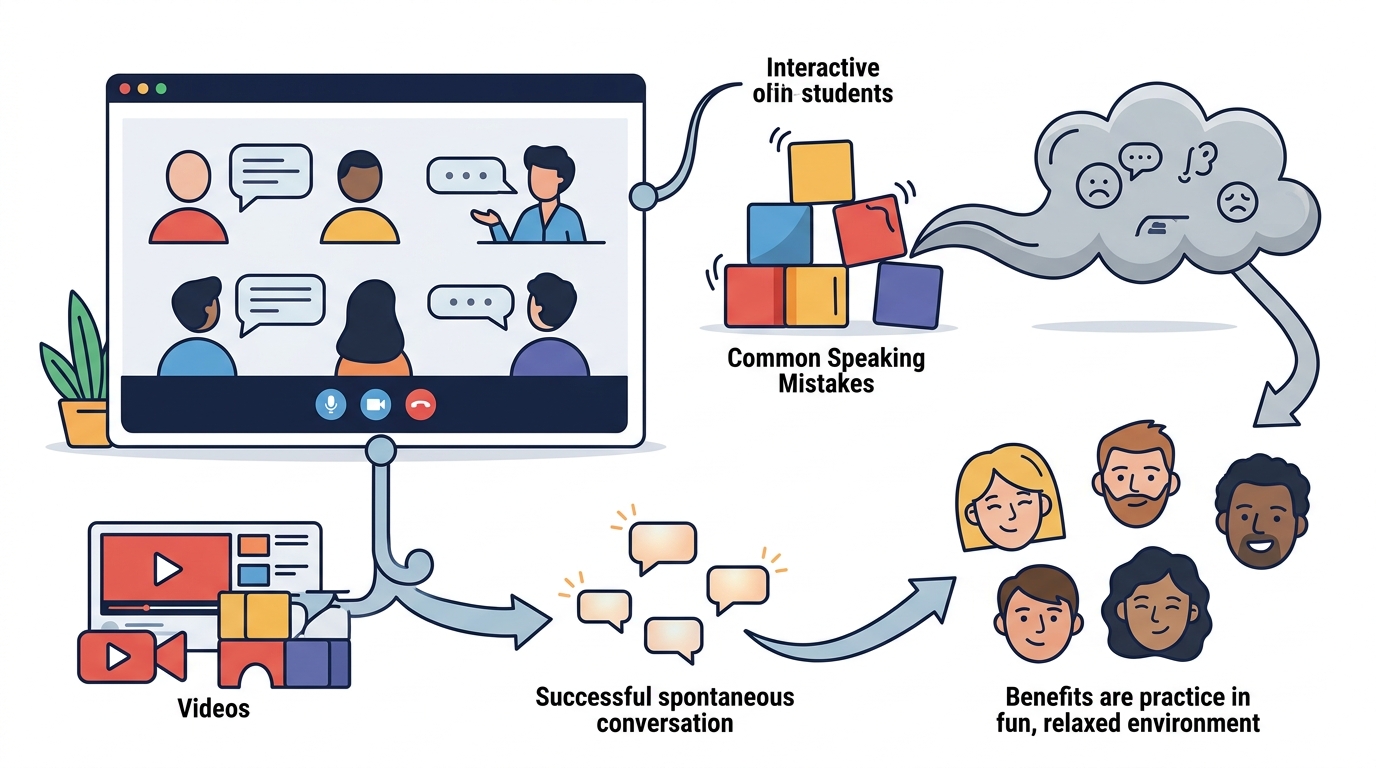
Joining a community like Pura Buena Onda provides the social scaffolding needed to overcome this fear. Our small-group classes ensure that you get personal attention while still experiencing the dynamics of group interaction. You learn from others' mistakes and successes. This shared experience reduces the feeling of being alone in your struggle.
Key Takeaways
- Translation is a crutch: Stop translating word-for-word. Focus on learning phrases and chunks of language to improve fluency and reduce cognitive load.
- Perfectionism blocks progress: Accept that mistakes are part of the learning process. Aim for communication, not grammatical precision, in early stages.
- Silence is acceptable: Use filler phrases in Spanish to manage pauses. Do not fear silence; use it to process information.
- Active use is critical: Memorizing vocabulary is not enough. You must use new words in conversation immediately to build active recall.
- Community reduces anxiety: Learning in isolation amplifies fear. Joining a supportive group provides feedback and shared experience.
- Consistency beats intensity: Daily practice, even for short periods, is more effective than occasional long study sessions.
- Real conversations drive fluency: Apps and books are supplements. Real human interaction is the primary driver of speaking ability.
Frequently Asked Questions
How long does it take to overcome language anxiety?
There is no fixed timeline, as anxiety is a personal response. However, consistent exposure to low-stakes speaking environments can reduce anxiety significantly within a few months. Our students often report feeling more comfortable after just a few weeks of regular class attendance.
Is it better to take private or group classes for anxiety?
It depends on your personality. Private classes offer maximum safety and customization. Group classes offer more realistic practice with peer interaction. Many students start with private sessions to build confidence before moving to groups. You can explore our private Spanish classes or semi-private options to find the right fit.
Can I learn Spanish effectively without speaking?
You can learn vocabulary and grammar without speaking, but you will not develop speaking fluency. Fluency requires the physical act of producing sounds and the cognitive act of formulating thoughts in real-time. Without speaking practice, your ability to communicate will remain limited.
What is the Pura Buena Onda approach to mistakes?
We view mistakes as essential data points. They show you what you need to work on. Our teachers provide gentle, real-time corrections in a supportive manner. We believe that a relaxed environment is key to learning. This is why we emphasize pura buena onda in all our interactions.
Do you offer classes for beginners who are afraid to speak?
Yes. We have specific levels for beginners. Our teachers are trained to guide absolute beginners through their first conversations. We focus on building confidence before complexity. You can check our 2026 Group Class Schedule to see available times.
How does the 90-Day Bootcamp help with anxiety?
The bootcamp provides structure and accountability. By committing to daily, small tasks, you build a habit of speaking without the pressure of a full class. The community aspect also helps, as you see others struggling and succeeding. This normalization of struggle reduces personal anxiety.
Are online classes as effective as in-person for overcoming anxiety?
For many people, online classes are less intimidating. The comfort of your own home can reduce the initial fear of speaking. Our online classes use Zoom to facilitate real-time interaction. While they lack the physical presence of in-person events, they are highly effective for building speaking confidence.
What is the definition of "pura buena onda"?
Pura buena onda is a Spanish phrase that translates to "pure good vibe." In our context, it refers to a relaxed, non-intimidating environment in which to learn and practice Spanish. It embodies our commitment to making language learning fun and stress-free.
Start Your Journey
Language anxiety is a common hurdle, but it is not a permanent barrier. By avoiding these common mistakes and embracing a supportive learning environment, you can unlock your speaking potential. Pura Buena Onda has been providing this supportive environment for 19 years. We invite you to join our community and experience the difference that real conversation makes.
Ready to break through your plateau? Contact us today to schedule a free consultation or sign up for the 90-Day Bootcamp. Your future fluent self is waiting.