

How to Practice Speaking Spanish in a Relaxed Environment
Speaking Spanish out loud can feel intimidating, especially if your only experience has been memorizing verb tables or tapping through a language app. The good news? You do not need a high-pressure classroom to make real progress. What you need is a supportive, conversational setting where mistakes are welcome and real-life topics drive the dialogue. In this guide, you will learn practical ways to build your speaking confidence, why relaxed practice matters according to research, and how schools like Pura Buena Onda in San Diego are designed to make Spanish practice feel more like happy hour than homework.
Why Speaking Practice Is the Fastest Path to Fluency
Speaking practice is the act of producing language out loud in real-time conversation rather than passively reading or listening. Research from the University of Wisconsin-Madison found that language learners who practice speaking outperform those who rely only on comprehension exercises. The study showed that producing language activates grammar, vocabulary, and pronunciation simultaneously, creating stronger memory retention.
According to the American Council on the Teaching of Foreign Languages (ACTFL), people who speak more than one language develop better memory, problem-solving skills, and concentration. Speaking is what turns passive knowledge into active mastery.
What Makes a "Relaxed Environment" for Language Learning?
A relaxed language learning environment is a setting where students feel safe making mistakes, where conversation topics are relevant to daily life, and where the social atmosphere encourages participation rather than perfection. Research has shown that higher levels of foreign language classroom anxiety can predict whether a student decides to stop studying altogether.
Real Topics, Real Conversations
The most effective relaxed environments use topics from your actual life: your job, your weekend plans, your family. At Pura Buena Onda, classes focus on what is actually happening in your world. As their team puts it, studying about a language is not the same as speaking it.
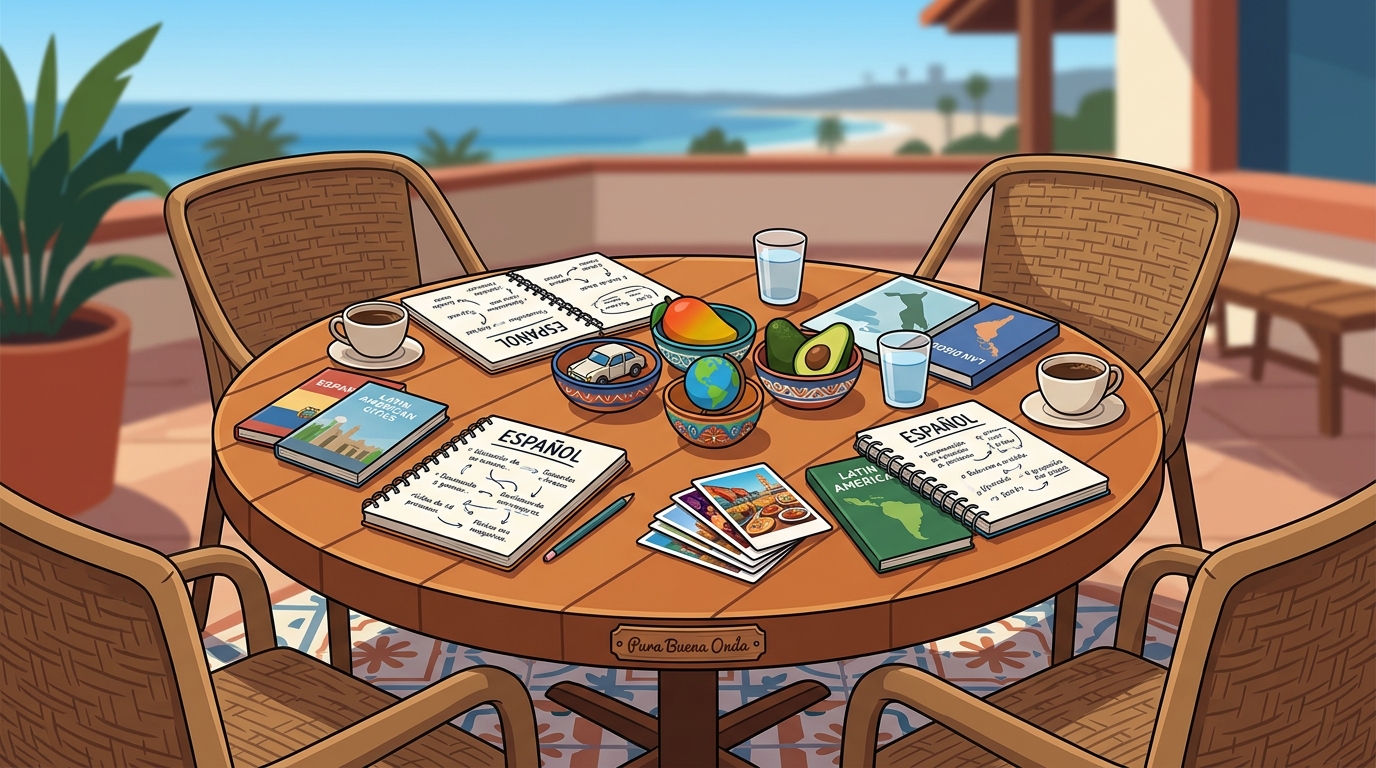
Community Over Competition
When classmates become friends, speaking feels natural. Many PBO students form genuine friendships through class, creating a community of people who share a love of Spanish and Latino culture. That social bond lowers anxiety and raises engagement.
Join Small-Group Conversation Classes
A small-group conversation class is a session with a limited number of students (typically six or fewer) focused primarily on speaking and listening. This format gives every participant meaningful talk time while still exposing them to vocabulary and perspectives they would not encounter alone.
Pura Buena Onda offers group Spanish conversation classes through flexible auto-renewing monthly memberships with four, six, or eight classes per month. Classes run Monday through Saturday with over 100 online scheduling choices each week, making it easy to stay consistent.
Why Consistency Matters
Consistency is incredibly important when learning a language. Regular weekly attendance builds the neural pathways that strengthen retention and develops confidence over time. Even one class per week, paired with daily micro-practice, produces noticeable results.
Try Private or Semi-Private Sessions
If group settings are not your style, or if you want to accelerate past a plateau, private and semi-private Spanish classes offer focused one-on-one or two-person sessions. A private class is a 60-minute session between you and your instructor, tailored entirely to your goals. Semi-private classes let you bring a partner at the same level.
For students stuck at intermediate levels, switching to private classes for six to twelve months can help push past that wall. Sixty focused minutes with a teacher can move you further than a 90-minute group session if speed is your priority.
Build Daily Speaking Habits Outside of Class
Class time is the engine, but daily habits are the fuel. Here are practical ways to add Spanish speaking into your routine:
- Think in Spanish. Narrate your morning routine silently (or out loud) in Spanish.
- Label your environment. Put sticky notes on household items with their Spanish names and say them every time you pass.
- Follow Spanish-language media. Listen to podcasts or news in Spanish for at least 15 minutes daily.
- Join a challenge. Pura Buena Onda runs a 30-for-30-in-30 Spanish challenge designed to build daily habits in just one month.
- Use Spanish socially. Attend Spanish-language meetups or social events. PBO hosts in-person events in San Diego and online gatherings throughout the year.
Comparing Spanish Practice Formats
Choosing the right format depends on your learning style, schedule, and budget. Here is how the main options compare:
| Format | Class Size | Speaking Time per Student | Best For | Flexibility |
|---|---|---|---|---|
| Small Group Class | 3-6 students | Moderate | Social learners, building vocabulary through peers | High (100+ weekly time slots) |
| Semi-Private Class | 2 students | High | Pairs at the same level who want more talk time | High |
| Private Class | 1 student | Maximum | Accelerating past plateaus, custom curriculum | Very High |
| Language Apps | Solo | Minimal (no live interaction) | Supplementary vocabulary building | Very High |
| In-Person Meetups | Varies | Varies | Casual practice, cultural immersion | Low (event-based) |
The most effective learners often combine two or more formats. A weekly group class plus daily app practice plus monthly social events creates a well-rounded routine.
Key Takeaways
- Speaking practice creates stronger memory retention than passive study methods like reading or listening alone.
- A relaxed, non-intimidating environment reduces language anxiety and keeps learners enrolled longer.
- Small-group conversation classes (six students or fewer) give you meaningful speaking time while exposing you to new vocabulary from peers.
- Private and semi-private sessions are ideal for breaking through intermediate plateaus.
- Daily micro-habits like thinking in Spanish or following Spanish-language media compound your classroom gains.
- Consistency matters more than intensity. Four classes per month beats one marathon session.
- Community and friendship in class lower inhibition and make practice feel natural.
Frequently Asked Questions
Do I need prior Spanish knowledge to join a conversation class?
No. Schools like Pura Buena Onda offer beginner-level group classes where students have their first real conversation on day one. A level assessment helps place you in the right class.
Are online Spanish classes as effective as in-person classes?
Yes. All Pura Buena Onda classes are held online via Zoom, and the school reports strong student advancement across all eight levels. Online classes also offer greater scheduling flexibility.
How many classes per week should I take?
Most students see solid progress with one to two classes per week. PBO offers memberships of four, six, or eight classes per month so you can choose what fits your life.
What if I feel too nervous to speak in front of others?
That is completely normal. A relaxed environment with small class sizes (six students max) and supportive instructors helps ease anxiety quickly. Private classes are also available if you prefer to start one-on-one.
How is a conversation class different from a traditional Spanish class?
Traditional classes focus on grammar rules, verb conjugation on paper, and memorization. Conversational Spanish classes focus on producing language out loud, discussing real-life topics, and receiving immediate feedback from a native-speaking instructor.
Can speaking practice actually improve my listening skills too?
Yes. Research published by the Association for Psychological Science found that production practice improves not only speaking ability but also comprehension of others speaking the language.
What does "buena onda" mean?
Buena onda is a Latin American Spanish expression that roughly translates to "good vibes." It captures the fun, positive atmosphere that defines Pura Buena Onda's approach to language learning.
Start Speaking Spanish This Week
You do not need to wait until you feel "ready." The best way to get comfortable speaking Spanish is to start speaking Spanish, in a place where it is okay to stumble. Contact Pura Buena Onda today to schedule your free level assessment and find the class that fits your life. Your first real Spanish conversation is one step away.