
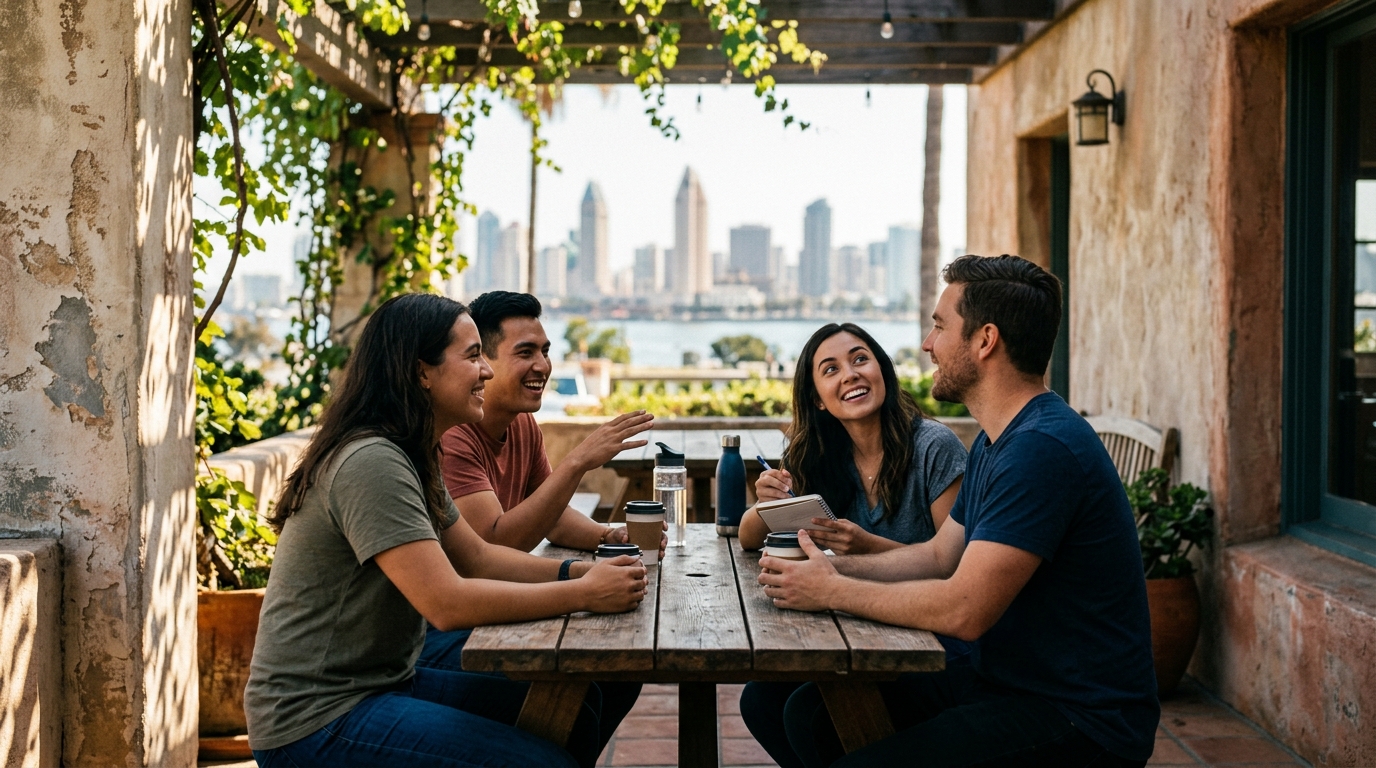
San Diego is one of the best cities in the United States to learn Spanish. With a large bilingual population and close proximity to Mexico, the opportunities to practice are everywhere. But choosing the right Spanish language school can feel overwhelming. Class formats, teacher qualifications, scheduling flexibility, and community culture all matter. This guide breaks down the key factors you should evaluate before enrolling so you can find a program that fits your learning style, schedule, and goals.
Why a Conversational Focus Matters Most
A conversational Spanish class is a language course built around real-time speaking practice rather than textbook drills. Research from the American Council on the Teaching of Foreign Languages (ACTFL) consistently shows that communicative approaches produce faster gains in oral proficiency than grammar-translation methods alone.
Look for schools where speaking begins on day one. Programs like Pura Buena Onda's conversational Spanish classes prioritize live dialogue, role-playing, and discussion topics that mirror real-world situations. That hands-on practice is what moves you from understanding vocabulary to actually using it in conversation.
Class Size and Student-to-Teacher Ratio
Small class size is one of the strongest predictors of language learning success. When groups are capped at four to six students, every person gets meaningful speaking time each session.
Pura Buena Onda keeps its small group Spanish classes intentionally small so learners at every level receive personalized feedback. Compare that to university courses that often seat 25 or more students, which leaves very little room for individual practice.
What to Ask Before You Enroll
- What is the maximum number of students per class?
- Are students grouped by proficiency level?
- How much speaking time does each student get per session?

Teacher Qualifications and Native Fluency
A qualified Spanish teacher is an instructor who combines native or near-native fluency with formal training in language pedagogy. Teaching a language well requires more than just speaking it. Great instructors understand error correction techniques, scaffolding strategies, and how to adapt to each student's pace.
Schools like Pura Buena Onda employ a diverse team of native Spanish-speaking teachers from multiple Latin American countries. Exposure to varied accents and regional vocabulary prepares you for real conversations outside the classroom, whether you are traveling to Mexico City, Buenos Aires, or Madrid.
Class Formats: Group, Private, and Semi-Private
The best Spanish school in San Diego will offer multiple class formats so you can match the structure to your goals.
Group Classes
Group classes are ideal for learners who benefit from peer interaction and want an affordable option. You practice listening and responding in real time with classmates at a similar level.
Private Classes
Private classes give you one-on-one attention and a fully customized curriculum. A private lesson is a dedicated session where the teacher tailors every minute to your specific weaknesses and goals.
Semi-Private Classes
Semi-private classes split the difference, pairing you with one or two other students for a balance of affordability and individual attention.
Scheduling Flexibility and Online Options
Adult learners juggle work, family, and other commitments. A rigid schedule can derail even the most motivated student. Look for a school that offers both daytime and evening sessions, plus the option to attend from home.
Pura Buena Onda provides online Spanish classes alongside in-person sessions in San Diego. Their flexible scheduling options let you pick times that work for your week, making it easier to stay consistent over months of study.
Community Culture and Immersion Events
Language learning does not stop at the classroom door. The most effective schools create a community where students connect, practice, and stay motivated between sessions. According to the Center for Applied Linguistics, social interaction in the target language dramatically improves retention and confidence.
Pura Buena Onda, founded by Caro, a native Chilean Spanish teacher, is known for its welcoming atmosphere and social events. Read what students have to say on the testimonials page to understand why community matters.
Comparing San Diego Spanish Schools at a Glance
| Feature | What to Look For | Why It Matters |
|---|---|---|
| Class Size | 4-6 students max | More speaking time per student |
| Teaching Method | Conversation-based | Builds real-world fluency faster |
| Teacher Background | Native speakers with pedagogy training | Authentic accent exposure + effective instruction |
| Class Formats | Group, private, and semi-private | Flexibility to match goals and budget |
| Online Option | Live virtual classes available | Consistency when you cannot attend in person |
| Community Events | Social gatherings and immersion activities | Practice outside the classroom |
| Level Assessment | Placement test before enrollment | Ensures you join the right group |
Key Takeaways
- Prioritize schools that use a conversational, speaking-first approach over grammar-heavy methods.
- Small class sizes (four to six students) ensure you get enough speaking practice each session.
- Native-speaking teachers with formal pedagogy training offer the best combination of authenticity and instructional skill.
- Multiple class formats (group, private, semi-private) let you tailor the experience to your budget and learning goals.
- Flexible scheduling and online class options help busy adults stay consistent over time.
- A strong school community with social events and immersion activities accelerates retention and builds confidence.
- Always request a level assessment before enrolling to make sure you are placed in the right group.
Frequently Asked Questions
How do I know which Spanish level I am?
Most reputable schools offer a free assessment before you start. Pura Buena Onda provides a placement assessment so you are matched with the right group from day one.
Are online Spanish classes as effective as in-person?
Yes, when the class is live and interactive. Virtual classes with small groups and a skilled teacher can be just as effective as in-person sessions. The key is real-time conversation, not pre-recorded videos.
How long does it take to become conversational in Spanish?
The U.S. Foreign Service Institute (FSI) estimates that English speakers need roughly 600 to 750 class hours to reach professional proficiency in Spanish. With consistent weekly classes and daily practice, many students hold basic conversations within three to six months.
What is the difference between group and private Spanish classes?
Group classes offer peer interaction and are more affordable. Private classes provide fully customized instruction at your own pace. Semi-private classes offer a middle ground with two to three students.
Why is San Diego a great city to learn Spanish?
San Diego sits just north of the U.S.-Mexico border and has a large Spanish-speaking population. This means daily opportunities to practice outside the classroom, from local restaurants to community events.
How much do Spanish classes in San Diego cost?
Rates vary by school and format. Group classes are typically the most affordable option. You can review Pura Buena Onda's current rates for a transparent breakdown of pricing.
Do I need any materials or textbooks?
Many conversation-focused schools provide their own materials. Pura Buena Onda uses custom resources, including homework assignments, mini-lessons, and a blog with Spanish learning tips, so you do not need to purchase separate textbooks.
Start Your Spanish Journey
Choosing the right Spanish school is the first step toward real fluency. If you are looking for a conversational, community-driven program in San Diego with native teachers and flexible scheduling, sign up for a free assessment at Pura Buena Onda and find out which level is right for you.