

If you have ever wondered whether online Spanish classes can actually help you speak fluently, you are not alone. Millions of learners weigh the convenience of virtual courses against the fear that they will never develop real conversational skills. The good news is that research increasingly supports online language education, especially when courses prioritize live interaction over passive study. In this post we break down what the evidence says, what makes an online course effective, and how to choose the right program for your fluency goals.
What Fluency Really Means
Fluency is the ability to communicate smoothly and spontaneously in a language without excessive pausing or hesitation. It is not the same as perfection. Many learners set an unrealistic bar, believing they must sound like a native speaker before they can call themselves fluent.
Linguists distinguish between accuracy (correct grammar and vocabulary) and fluency (speed and ease of delivery). Both matter, but conversational fluency develops primarily through speaking practice, not just studying. Understanding this distinction helps you pick the right course format.
What the Research Says About Online Language Courses
A growing body of academic work shows that online instruction can match or exceed traditional classroom results. A 2024 study published in the American Journal of Distance Education found that online Dutch L2 learning in adult education was at least as effective as on-ground learning, with Spanish and French sections sometimes outperforming their in-person counterparts.
A 2020 study in the Journal of Educational Technology similarly reported that students in online language courses achieved comparable or better outcomes when courses included interactive elements. However, research also highlights a challenge: online formats can produce greater variability in student performance, especially for productive skills like speaking and writing.
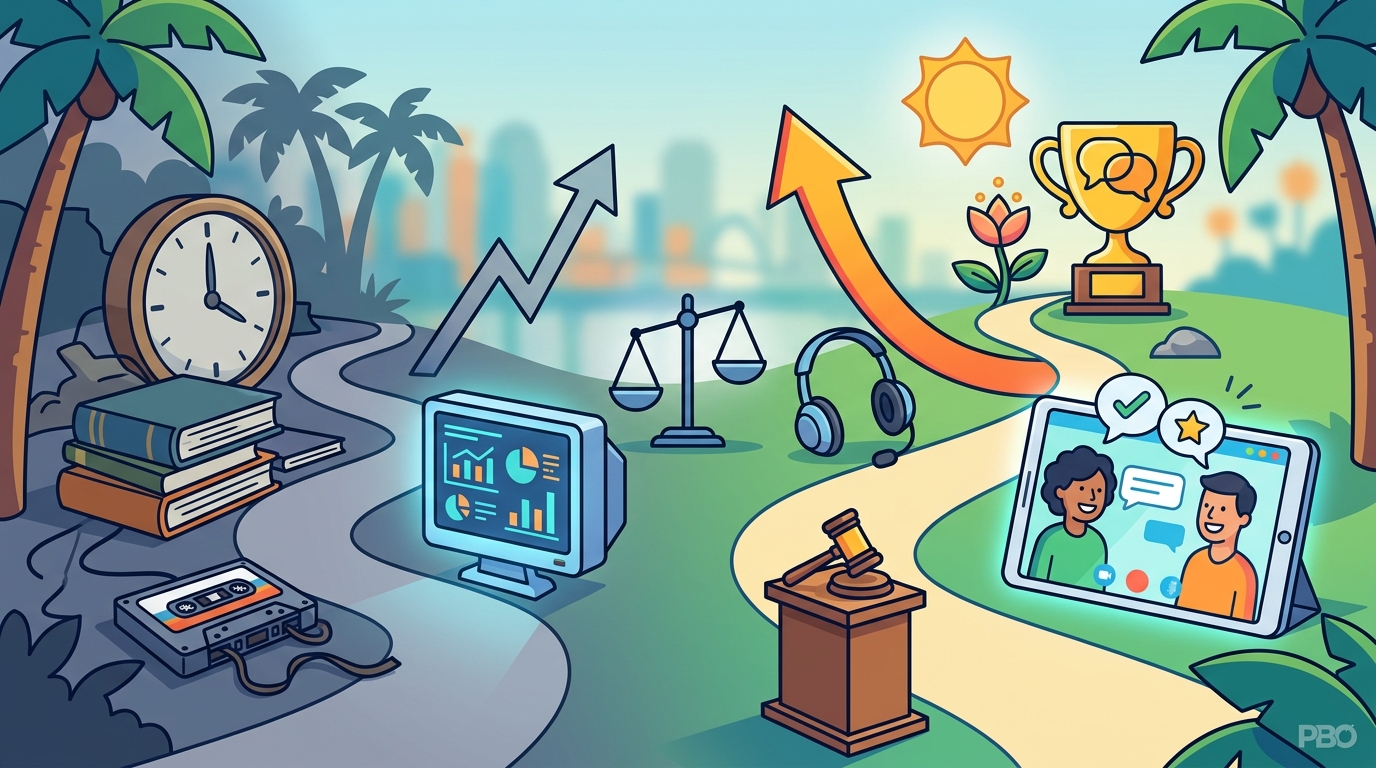
The Fluency Gap in Passive Online Courses
A 2023 study in the Journal of Psycholinguistic Research tracked 45 university students over a semester of online instruction and found that speaking accuracy improved significantly, but speaking fluency did not. The researchers noted that online courses often lacked chances for spontaneous group talk, so learners had fewer opportunities for real communication.
The takeaway is clear: online courses work, but only when they are designed around live, unscripted conversation.
Why Conversation Is the Missing Ingredient
Conversational practice is the repeated, real-time exchange of ideas between speakers in a target language. Apps and self-paced modules build vocabulary and grammar knowledge, yet they rarely require you to think on your feet.
A 2023 study in Frontiers in Psychology demonstrated that online language exchanges, where learners spoke with foreign partners in real time, were more effective at improving fluency and willingness to communicate than conventional instruction alone. Live interaction forces you to recall words under pressure, self-correct, and build the neural pathways that create true fluency.
Online vs. In-Person Spanish Classes
| Factor | Online Courses | In-Person Courses |
|---|---|---|
| Schedule flexibility | High; join from anywhere | Fixed time and location |
| Access to native speakers | Global teacher pool | Limited to local instructors |
| Speaking practice | Depends on course design | Natural in small groups |
| Cost | Often lower overhead | Higher due to venue |
| Accountability | Requires self-discipline | Built-in structure |
| Technology needs | Stable internet, webcam | None |
The best online programs close the speaking gap by keeping class sizes small and requiring cameras on. If you are curious about what that experience looks like, read student testimonials from Pura Buena Onda to hear firsthand accounts.
What to Look for in an Online Spanish Course
Live Instruction with Native Speakers
Pre-recorded videos cannot replace a teacher who adjusts to your mistakes in real time. Look for programs staffed by qualified native-speaking instructors from diverse Spanish-speaking countries.
Small Group or Private Formats
Classes larger than eight students make it hard to get meaningful speaking time. Small group conversational classes, semi-private sessions, and private lessons give you the repetitions you need.
Clear Level Progression
Effective programs assess your starting point and move you through defined levels. Knowing how long it takes to become fluent in Spanish helps you set realistic expectations and stay motivated.
How Pura Buena Onda Bridges the Gap
Pura Buena Onda is a San Diego-based Spanish language school that specializes in conversational classes delivered both online and in person. Every class prioritizes live speaking, and students are grouped by level so no one is left behind or held back.
Whether you prefer online Spanish classes from your living room or in-person conversation classes in San Diego, the teaching method stays the same: maximum talk time, minimum lecture. The school also offers topic-based courses like The Subjunctive Made Simple and challenges like the 30 for 30 in 30 Challenge to keep learners engaged between sessions.
Key Takeaways
- Online Spanish courses can be just as effective as in-person classes when they include live, interactive speaking practice.
- Passive or self-paced courses often improve grammar accuracy but fail to develop speaking fluency.
- Research shows that online language exchanges with real conversation partners significantly boost fluency and confidence.
- Small class sizes and native-speaking instructors are non-negotiable for quality online learning.
- Fluency is smooth, spontaneous communication, not grammatical perfection.
- Consistency matters more than intensity; flexible online scheduling helps you show up regularly.
- Choosing a conversation-first school like Pura Buena Onda ensures your online time translates to real-world speaking ability.
Frequently Asked Questions
Can I really become fluent in Spanish through online classes?
Yes. Studies show online students can match in-person outcomes when courses include interactive speaking components and regular practice with native speakers.
How long does it take to speak Spanish fluently online?
The U.S. Foreign Service Institute estimates roughly 600 to 750 class hours for English speakers to reach professional proficiency in Spanish. Consistent online classes with weekly practice can get you conversational within one to two years.
Are apps like Duolingo enough for fluency?
Apps are great supplemental tools for vocabulary and grammar drills, but they do not provide the live, spontaneous speaking practice needed to develop true conversational fluency.
What is the best online Spanish class format?
Small group classes (four to eight students) with a native-speaking instructor offer the best balance of cost-effectiveness and individual speaking time.
How does Pura Buena Onda teach online?
Pura Buena Onda uses live virtual sessions with native-speaking teachers, small group sizes, and a conversation-first methodology. Classes are available in group, semi-private, and private formats.
Do I need prior Spanish knowledge to start?
No. Pura Buena Onda offers classes for complete beginners through advanced speakers. You can start with a free assessment to find your level.
Is online Spanish class worth the money compared to free resources?
Free resources build knowledge, but structured classes with live feedback accelerate fluency. The accountability and interaction of a paid course are difficult to replicate on your own.
Can I take online classes if I live outside San Diego?
Absolutely. Pura Buena Onda's online classes are open to students anywhere in the world, so geography is never a barrier.
Ready to Start Speaking Spanish?
Stop studying Spanish in silence and start speaking it with real people. Book your free assessment with Pura Buena Onda today and find out which class level is right for you.