
Common Duolingo Mistakes Adult Spanish Learners Make and How to Fix Them
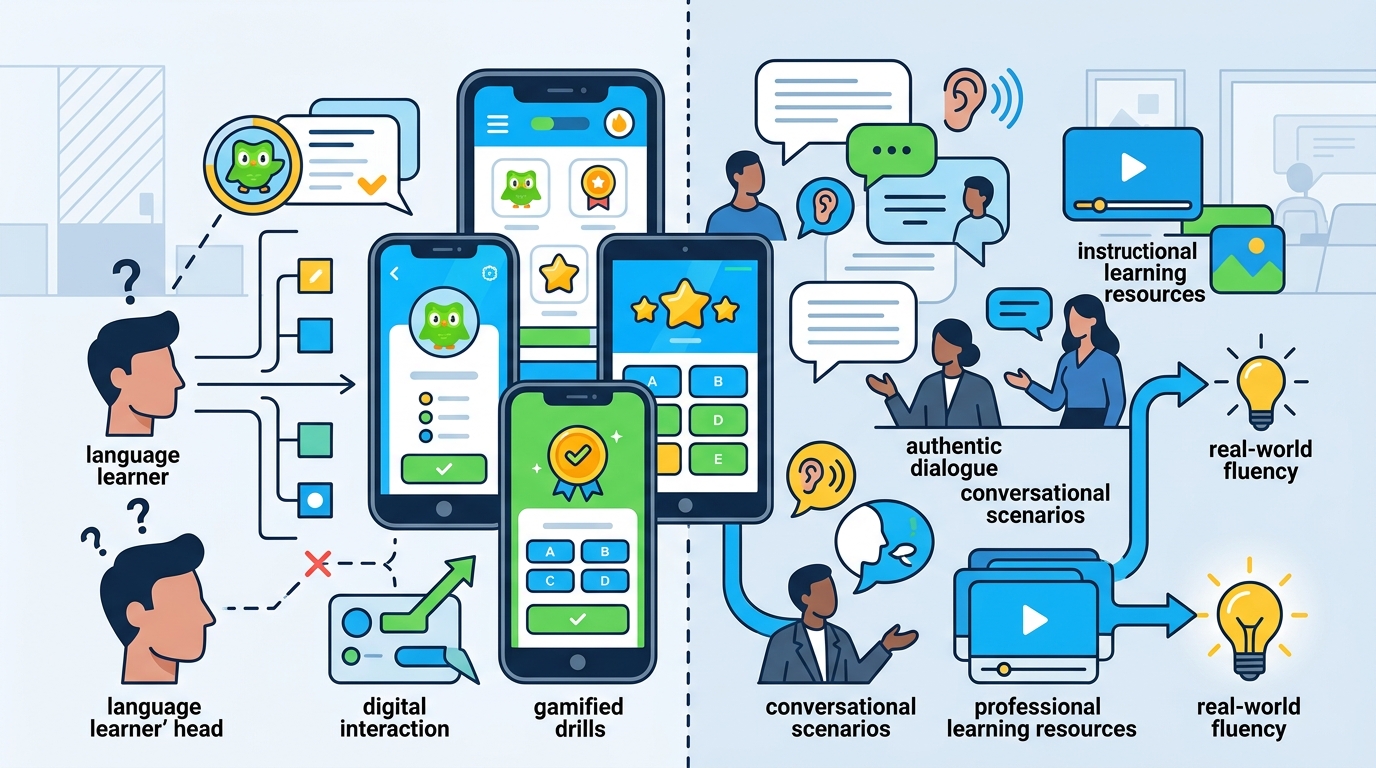
Language learning has evolved dramatically in the last decade, shifting from expensive classroom hours to pocket-sized gamification. However, relying solely on apps like Duolingo often leads to a frustrating plateau for adult learners. Learners who rely exclusively on gamified apps often struggle with real-time conversation because they lack the necessary speaking practice. This article explores the critical gaps in app-based learning and provides actionable strategies to bridge the divide between digital drills and real-world fluency.
The Passive Listening Trap
One of the most common pitfalls for adult learners is treating Spanish as a passive subject rather than an active skill. Duolingo excels at vocabulary retention through repetition, but it rarely forces you to produce language spontaneously. You might recognize the word for "apple" instantly, but freeze when asked to order one in a café.
Spanish is a phonetic language, meaning the way you write it closely matches how it sounds. Apps often fail to correct subtle pronunciation errors because they rely on text-based inputs. To fix this, you must engage in active output. This means speaking out loud during every lesson, even if you are just repeating the prompt. At Pura Buena Onda, we emphasize that fluency happens when you stop memorizing and start speaking. You need to train your mouth muscles to form Spanish sounds, not just your brain to recognize them.
Reading about a skill and performing it are two very different things, and speaking a language is no exception. You must get real practice producing the words out loud. This principle is central to our approach at Pura Buena Onda, where we prioritize real-life conversations over stuffy grammar drills.
Ignoring Grammar Context
Adult learners often struggle with the subjunctive mood and verb conjugations because apps teach these in isolation. Duolingo might ask you to translate "I want to eat," but it rarely explains why the verb changes form in Spanish. Without context, grammar rules feel like arbitrary obstacles rather than tools for expression.
The subjunctive is a mood used to express doubt, desire, or possibility. It is not just a rule to memorize; it is a way of thinking. When you learn grammar in a vacuum, you miss the emotional nuance that makes language rich. For example, understanding the difference between "ser" and "estar" is crucial. Ser is used for permanent characteristics, while estar is used for temporary states or locations. This distinction is often glossed over in app lessons.
To fix this, you need structured guidance that explains the "why" behind the rules. Our Patreon offers grammar courses that break down these complex topics in a way that makes sense. We provide interviews with native teachers who explain how Spanish actually sounds across different countries, helping you understand the logic behind the language.
The Fear of Speaking
Perhaps the biggest mistake adult learners make is waiting until they are "ready" to speak. Apps create a safe, judgment-free zone that can actually hinder your progress. You might feel confident translating sentences on your phone, but the moment you face a human being, anxiety takes over. This is because apps do not simulate the pressure of real-time interaction.
Real-life Spanish needs real-life conversations with other humans. You need to experience the awkwardness of making mistakes in a supportive environment. At PBO, our semi-private and private classes offer more individualized attention, while our small-group classes create a collaborative, conversation-focused setting. Our instructors are here to guide you, cheer you on, and laugh at your joke that you can almost say fluently. This zero-judgment environment is essential for overcoming the fear of speaking.
Frequent, low-stakes speaking practice is one of the most effective ways to build real conversational confidence, especially compared to relying on input-only study. You must force yourself to speak, even if it feels uncomfortable. Joining a community of adult learners doing the same awkward, brave thing you are can make this process much less daunting.
Lack of Cultural Nuance
Language is deeply tied to culture. Apps often teach textbook Spanish that sounds robotic to native speakers. You might learn to say "my in-laws are driving me crazy," but you will rarely learn the idiomatic expressions that make you sound like a local. This is where the "vibe" of the language gets lost.
Pura buena onda is defined as a relaxed, non-intimidating environment in which to learn and practice Spanish. It is also a good vibe, a positive connection between people. Understanding these cultural nuances is key to building genuine connections. Our social club events are held online via Zoom, giving you the perfect setting to practice these nuances in real time, wherever you're located.
We offer vocabulary that makes you sound more native, not more textbook. This includes tips, tricks, and shortcuts that are rarely found in standard apps. By engaging with our blog and social media channels, you can access daily conversation prompts and idioms that are corrected by our teachers the next day. This free feedback loop is invaluable for understanding how Spanish is actually used in daily life.
Inconsistent Practice Habits
Apps like Duolingo rely on streaks to motivate users, but this can create a fragile habit. If you miss a day, you might feel discouraged and quit entirely. Real language learning requires consistency, not just intensity. It is better to practice for 20 minutes every day than for two hours once a week.
The PBO 90-Day Spanish Bootcamp is designed to address this exact issue. It combines daily practice, weekly accountability, and a supportive community to give your Spanish a serious boost. By committing to daily tasks like responding to our conversation question on Facebook and engaging with our Instagram posts, you build a sustainable habit. This bootcamp is not just about learning words; it is about building a routine that sticks.
Our classes are held online via Zoom, offering flexibility for those with packed schedules. We offer several classes per level each week, and you can request a schedule that works for you. Life happens, and we are here to roll with it. This month-to-month flexibility ensures that you can maintain your practice without the guilt of rigid contracts.
Comparison of Learning Methods
To help you decide the best path forward, here is a comparison of common learning methods:
| Method | Pros | Cons | Best For |
|---|---|---|---|
| Duolingo | Accessible, gamified, good for vocabulary | Lacks speaking practice, robotic speech | Beginners building a habit |
| Traditional Classes | Structured, teacher-led | Expensive, rigid schedule | Those who need strict accountability |
| PBO Small-Group Classes | Real conversation, flexible, fun | Requires active participation | Adults seeking fluency |
| Private Tutoring | Personalized, fast progress | Higher cost | Specific goal achievement |
Key Takeaways
- Apps like Duolingo are excellent for vocabulary but fail to teach spontaneous speaking.
- Grammar must be learned in context to understand its emotional and functional nuance.
- Overcoming the fear of speaking requires a safe, non-judgmental environment.
- Cultural nuance is best learned through interaction with native speakers.
- Consistency is more important than intensity; daily practice yields better results.
- Pura Buena Onda has been creating a relaxed, fun, 100% online environment for 19 years.
- Our 8-level system helps place you with students at a similar skill level.
Frequently Asked Questions
Can I learn Spanish fluently using only Duolingo?
No. While Duolingo is a great tool for building vocabulary and maintaining a daily habit, it lacks the speaking practice necessary for fluency. You must engage in real conversations to produce the language.
How does Pura Buena Onda differ from traditional Spanish classes?
We focus on conversational Spanish rather than grammar drills. Our classes are small, flexible, and designed to be fun and non-intimidating. We prioritize real-life conversations with native speakers.
Do I need to be in San Diego to take classes?
No. Pura Buena Onda is 100% online, for everyone, everywhere. Our classes and social events are all held online via Zoom, making them accessible to anyone with an internet connection, no matter where you live.
What is the PBO 90-Day Spanish Bootcamp?
It is a challenge that combines daily practice, weekly accountability, and a supportive community. It is designed to help you break through your plateau and build a sustainable Spanish-learning routine.
How much does it cost to join PBO?
We offer flexible class membership options, along with a Bootcamp option and a Patreon membership that includes additional resources like grammar courses and native speaker interviews. Pricing varies by option — the best way to get current details is to book a free consultation.
Is there a minimum commitment for classes?
No. We offer month-to-month flexibility with no contracts. You can join or leave at any time, allowing you to fit Spanish into your life without guilt.
What levels do you offer?
We offer 8 levels, helping ensure you're placed with students at a similar skill level for a more comfortable, productive learning experience.
Ready to Break Your Plateau?
Stop letting apps dictate your progress. It is time to get off the screen and into the conversation. Whether you choose our small-group classes, private tutoring, or the 90-Day Bootcamp, you will gain the confidence and conversational skills you have been seeking. Reach out to see our current class schedule and pricing options, or book a free consultation to get started today. Let us help you find your pura buena onda.